


2025 Latest Terraform-Associate-003 dumps Exam Material with 226 Questions
HashiCorp Terraform-Associate-003 Questions and Answers Guarantee you Oass the Test Easily
HashiCorp Terraform-Associate-003 Exam Syllabus Topics:
| Topic | Details |
|---|---|
| Topic 1 |
|
| Topic 2 |
|
| Topic 3 |
|
| Topic 4 |
|
| Topic 5 |
|
NEW QUESTION # 29
Define the purpose of state in Terraform.
- A. State lets you enforce resource configurations that relate to compliance policies
- B. State stores variables and lets you quickly reuse existing code
- C. State codifies the dependencies of related resources
- D. State maps real world resources to your configuration and keeps track of metadata
Answer: D
Explanation:
The purpose of state in Terraform is to keep track of the real-world resources managed by Terraform, mapping them to the configuration. The state file contains metadata about these resources, such as resource IDs and other important attributes, which Terraform uses to plan and manage infrastructure changes. The state enables Terraform to know what resources are managed by which configurations and helps in maintaining the desired state of the infrastructure.References= This role of state in Terraform is outlined in Terraform's official documentation,emphasizing its function in mapping configuration to real-world resources and storing vital metadata .
NEW QUESTION # 30
Which of the following arguments are required when declaring a Terraform output?
- A. description
- B. sensitive
- C. default
- D. value
Answer: D
Explanation:
When declaring a Terraform output, thevalueargument is required. Outputs are a way to extract information from Terraform-managed infrastructure, and thevalueargument specifies what data will be outputted. While other arguments likedescriptionandsensitivecan provide additional context or security around the output, valueis the only mandatory argument needed to define an output.References= The requirement of thevalue argument for outputs is specified in Terraform's official documentation, which provides guidelines on defining and using outputs in Terraform configurations.
NEW QUESTION # 31
Where in your Terraform configuration do you specify a state backend?
- A. The terraform block
- B. The provider block
- C. The resource block
- D. The data source block
Answer: A
Explanation:
In Terraform, the backend configuration, which includes details about where and how state is stored, is specified within the terraform block of your configuration. This block is the correct place to define the backend type and its configuration parameters, such as the location of the state file for a local backend or the bucket details for a remote backend like S3.
Reference = This practice is outlined in Terraform's core documentation, which provides examples and guidelines on how to configure various aspects of Terraform's behavior, including state backends .
NEW QUESTION # 32
How could you reference an attribute from the vsphere_datacenter data source for use with the datacenter_id argument within the vsphere_folder resource in the following configuration?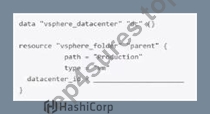
- A. Vsphere_datacenter.dc.id
- B. Data,dc,id
- C. Data.vsphere_datacenter,dc
- D. Data.vsphere_datacenter.DC.id
Answer: D
Explanation:
The correct way to reference an attribute from the vsphere_datacenter data source for use with the datacenter_id argument within the vsphere_folder resource in the following configuration is data.vsphere_datacenter.dc.id. This follows the syntax for accessing data source attributes, which is data.TYPE.NAME.ATTRIBUTE. In this case, the data source type is vsphere_datacenter, the data source name is dc, and the attribute we want to access is id. The other options are incorrect because they either use the wrong syntax, the wrong punctuation, or the wrong case. References = [Data Source: vsphere_datacenter], [Data Source: vsphere_folder], [Expressions: Data Source References]
NEW QUESTION # 33
Which argument can you use toprevent unexpected updatesto a module's configuration when calling Terraform Registry modules?
- A. lifecycle
- B. source
- C. count
- D. version
Answer: D
Explanation:
Comprehensive and Detailed in-Depth Explanation:
* Theversion argumentin a module ensures Terraform uses aspecific versionof a module, preventing unintended updates.
* A (source)- Specifies the module source butdoes not control versioning.
* B (count)- Controls how many instances of a resource/module exist,not updates.
* D (lifecycle)- Controls how resources behavebut does not control module versioning.
Official Terraform Documentation Reference:Module Version Constraints
NEW QUESTION # 34
You're writing a Terraform configuration that needs to read input from a local file called id_rsa.pub . Which built-in Terraform function can you use to import the file's contents as a string?
- A. file("id_rsa.pub")
- B. templaTefil("id_rsa.pub")
- C. fileset<"id_rsa.pub")
- D. filebase64("id_rsa.pub")
Answer: A
Explanation:
To import the contents of a local file as a string in Terraform, you can use the built-infilefunction. By specifyingfile("id_rsa.pub"), Terraform reads the contents of theid_rsa.pubfile and uses it as a string within your Terraform configuration. This function is particularly useful for scenarios where you need to include file data directly into your configuration, such as including an SSH public key for provisioning cloud instances.References= This information is a standard part of Terraform's functionality with built-in functions, as outlined in Terraform's official documentation and commonly used in variousTerraform configurations.
NEW QUESTION # 35
What kind of configuration block will create an infrastructure object with settings specified within the block?
- A. data
- B. resource
- C. provider
- D. state
Answer: B
Explanation:
This is the kind of configuration block that will create an infrastructure object with settings specified within the block. The other options are not used for creating infrastructure objects, but for configuring providers, accessing state data, or querying data sources.
NEW QUESTION # 36
How would you reference the volume IDs associated with the ebs_block_device blocks in this configuration?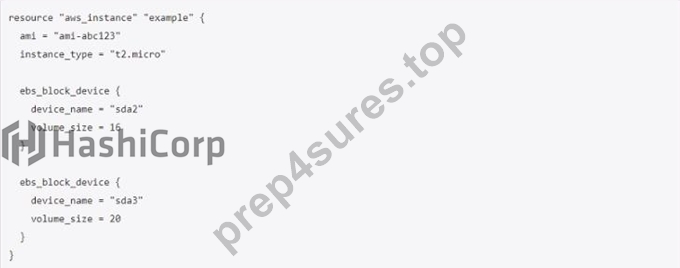
- A. aws_instance.example-ebs_block_device.*.volume_id
- B. aws_lnstance.example.ebs_block_device.volume_ids
- C. aws_lnstance.example.ebs_block_device.[*].volume_id
- D. aws_instance.example.ebs_block_device[sda2,sda3).volume_id
Answer: A
Explanation:
This is the correct way to reference the volume IDs associated with the ebs_block_device blocks in this configuration, using the splat expression syntax. The other options are either invalid or incomplete.
NEW QUESTION # 37
What does Terraform not reference when running a terraform apply -refresh-only ?
- A. Cloud provider
- B. Credentials
- C. Terraform resource definitions in configuration files
- D. State file
Answer: C
Explanation:
Explanation
When running a terraform apply -refresh-only, Terraform does not reference the configuration files, but only the state file, credentials, and cloud provider. The purpose of this command is to update the state file with the current status of the real resources, without making any changes to them1.
NEW QUESTION # 38
Which of the following is not a valid source path for specifying a module?
- A. source = "./module?version=vl.6.0"
- B. source - "hashicorp/consul/aws"
- C. source - "./module"
- D. source - "github.com/hashicorp/examplePref-ul.0.8M
Answer: A
Explanation:
Terraform modules are referenced by specifying a source location. This location can be a URL or a file path. However, specifying query parameters such as ?version=vl.6.0 directly within the source path is not a valid or supported method for specifying a module version in Terraform. Instead, version constraints are specified using the version argument within the module block, not as part of the source string.References = This clarification is based on Terraform's official documentation regarding module usage, which outlines the correct methods for specifying module sources and versions.
NEW QUESTION # 39
A terraform apply can not _________ infrastructure.
- A. change
- B. provision
- C. import
- D. destroy
Answer: C
Explanation:
The terraform import command is used to import existing infrastructure into Terraform's state. This allows Terraform to manage and destroy the imported infrastructure as part of the configuration. The terraform import command does not modify the configuration, so the imported resources must be manually added to the configuration after the import. Reference = [Importing Infrastructure]
NEW QUESTION # 40
How could you reference an attribute from the vsphere_datacenter data source for use with the datacenter_id argument within the vsphere_folder resource in the following configuration?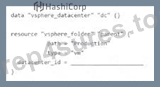
- A. Vsphere_datacenter.dc.id
- B. Data,dc,id
- C. Data.vsphere_datacenter,dc
- D. Data.vsphere_datacenter.DC.id
Answer: D
Explanation:
Explanation
The correct way to reference an attribute from the vsphere_datacenter data source for use with the datacenter_id argument within the vsphere_folder resource in the following configuration is data.vsphere_datacenter.dc.id. This follows the syntax for accessing data source attributes, which is data.TYPE.NAME.ATTRIBUTE. In this case, the data source type is vsphere_datacenter, the data source name is dc, and the attribute we want to access is id. The other options are incorrect because they either use the wrong syntax, the wrong punctuation, or the wrong case. References = [Data Source: vsphere_datacenter],
[Data Source: vsphere_folder], [Expressions: Data Source References]
NEW QUESTION # 41
What is a key benefit of the Terraform state file?
- A. A state file is a source of truth for resources provisioned with Terraform
- B. A state file is a source of truth for resources provisioned with a public cloud console
- C. A state file can schedule recurring infrastructure tasks
- D. A state file is the desired state expressed by the Terraform code files
Answer: A
Explanation:
Explanation
This is a key benefit of the Terraform state file, as it stores and tracks the metadata and attributes of the resources that are managed by Terraform, and allows Terraform to compare the current state with the desired state expressed by your configuration files.
NEW QUESTION # 42
You have deployed a new webapp with a public IP address on a cloud provider. However, you did not create any outputs for your code. What is the best method to quickly find the IP address of the resource you deployed?
- A. Run terraform state list to find the name of the resource, then terraform state show to find the attributes including public IP address
- B. In a new folder, use the terraform_remote_state data source to load in the state file, then write an output for each resource that you find the state file
- C. Run terraform output ip_address to view the result
- D. Run terraform destroy then terraform apply and look for the IP address in stdout
Answer: A
Explanation:
This is a quick way to inspect the state file and find the information you need without modifying anything5. The other options are either incorrect or inefficient.
NEW QUESTION # 43
You add a new resource to an existing Terraform configuration, but do not update the version constraint in the configuration. The existing and new resources use the same provider. The working contains a .terraform.lock, hc1 file.
How will Terraform choose which version of the provider to use?
- A. Terraform will use the latest version of the provider for the new resource and the version recorded in the lock file to manage existing resources
- B. Terraform will check your state file to determine the provider version to use
- C. Terraform will use the version recorded in your lock file
- D. Terraform will use the latest version of the provider available at the time you provision your new resource
Answer: C
Explanation:
Explanation
This is how Terraform chooses which version of the provider to use, when you add a new resource to an existing Terraform configuration, but do not update the version constraint in the configuration. The lock file records the exact version of each provider that was installed in your working directory, and ensures that Terraform will always use the same provider versions until you run terraform init -upgrade to update them.
NEW QUESTION # 44
Terraform can only manage resource dependencies if you set them explicitly with the depends_on argument.
- A. False
- B. True
Answer: A
Explanation:
Terraform can manage resource dependencies implicitly or explicitly. Implicit dependencies are created when a resource references another resource or data source in its arguments. Terraform can infer the dependency from the reference and create or destroy the resources in the correct order. Explicit dependencies are created when you use the depends_on argument to specify that a resource depends on another resource or module. This is useful when Terraform cannot infer the dependency from the configuration or when you need to create a dependency for some reason outside of Terraform's scope.
References = : Create resource dependencies : Terraform Resource Dependencies Explained
NEW QUESTION # 45
You have multiple team members collaborating on infrastructure as code (IaC) using Terraform, and want to apply formatting standards for readability.
How can you format Terraform HCL (HashiCorp Configuration Language) code according to standard Terraform style convention?
- A. Designate one person in each team to review and format everyone's code
- B. Manually apply two spaces indentation and align equal sign "=" characters in every Terraform file (*.tf)
- C. Write a shell script to transform Terraform files using tools such as AWK, Python, and sed
- D. Run the terraform fmt command during the code linting phase of your CI/CD process Most Voted
Answer: D
Explanation:
The terraform fmt command is used to rewrite Terraform configuration files to a canonical format and style. This command applies a subset of the Terraform language style conventions, along with other minor adjustments for readability. Running this command on your configuration files before committing them to source control can help ensure consistency of style between different Terraform codebases, and can also make diffs easier to read. You can also use the -check and -diff options to check if the files are formatted and display the formatting changes respectively2. Running the terraform fmt command during the code linting phase of your CI/CD process can help automate this process and enforce the formatting standards for your team. References = [Command: fmt]2
NEW QUESTION # 46
How would you reference the "name'' value of the second instance of this resource?
- A. aws_instance-web(1)
- B. Aws_instance,web,* , name
- C. element(aws_instance.web, 2)
- D. aws_instance.web(2),name
- E. aws_instance_web(1),name
Answer: E
Explanation:
In Terraform, when you use the count meta-argument, you can reference individual instances using an index. The indexing starts at 0, so to reference the "name" value of the second instance, you would use aws_instance.web[1].name. This syntax allows you to access the properties of specific instances in a list generated by the count argument.
References:
Terraform documentation on count and accessing resource instances: Terraform Count
NEW QUESTION # 47
When should you use the force-unlock command?
- A. You have a high priority change
- B. apply failed due to a state lock
- C. Automatic unlocking failed
- D. You see a status message that you cannot acquire the lock
Answer: C
Explanation:
You should use the force-unlock command when automatic unlocking failed. Terraform will lock your state for all operations that could write state, such as plan, apply, or destroy. This prevents others from acquiring the lock and potentially corrupting your state. State locking happens automatically on all operations that could write state and you won't see any message that it is happening. If state locking fails, Terraform will not continue. You can disable state locking for most commands with the -lock flag but it is not recommended. If acquiring the lock is taking longer than expected, Terraform will output a status message. If Terraform doesn't output a message, state locking is still occurring if your backend supports it. Terraform has a force-unlock command to manually unlock the state if unlocking failed. Be very careful with this command. If you unlock the state when someone else is holding the lock it could cause multiplewriters. Force unlock should only be used to unlock your own lock in the situation where automatic unlocking failed. To protect you, the force-unlock command requires a unique lock ID. Terraform will output this lock ID if unlocking fails. This lock ID acts as a nonce, ensuring that locks and unlocks target the correct lock. The other situations are not valid reasons to use the force-unlock command. You should not use the force-unlock command if you have a high priority change, if apply failed due to a state lock, or if you see a status message that you cannot acquire the lock. These situations indicate that someone else is holding the lock and you should wait for them to finish their operation or contact them to resolve the issue. Using the force-unlock command in these cases could result in data loss or inconsistency. References = [State Locking], [Command: force-unlock]
NEW QUESTION # 48
What is modified when executing Terraform inrefresh-only mode?
- A. Your state file.
- B. Your Terraform configuration.
- C. Your cloud infrastructure.
- D. Your Terraform plan.
Answer: A
Explanation:
Comprehensive and Detailed in-Depth Explanation:
* Inrefresh-only mode(terraform apply -refresh-only), Terraformupdates the state fileto match the actual infrastructurewithout modifying resources.
* A (Terraform configuration)-Not modifiedin refresh-only mode.
* B (Terraform plan)-Plan is generated but not modified.
* D (Cloud infrastructure)-Not modifiedin refresh-only mode.
Official Terraform Documentation Reference:Refresh-Only Mode
NEW QUESTION # 49
......
Share Latest Terraform-Associate-003 DUMP Questions and Answers: https://freedownload.prep4sures.top/Terraform-Associate-003-real-sheets.html