


[2025] Use Valid Exam P-BTPA-2408 by Prep4sures Books For Free Website
Free SAP Certified Professional P-BTPA-2408 Official Cert Guide PDF Download
NEW QUESTION # 19
A customer wants to establish connectivity between applications being executed by end users and the on- premise backend system (SAP S/4HANA).
Based on the attached diagram, which combination is necessary to establish the connectivity?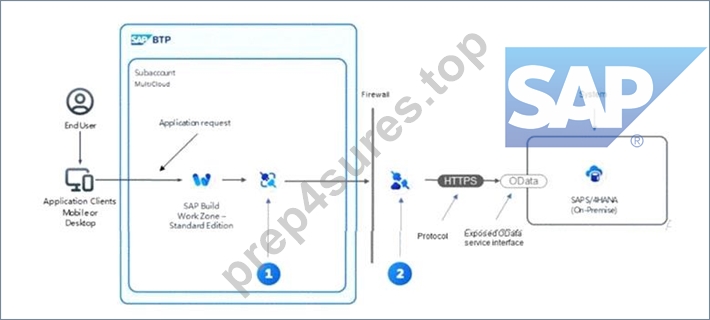
- A. Connectivity Service for 1 and Cloud Connector for 2
- B. Custom Connector for 1 and Connectivity Service for 2
- C. Destination Service for 1 and Connectivity Service for 2
- D. Cloud Connector for 1 and Destination Service for 2
Answer: A
Explanation:
To establish connectivity between the end-user applications and the SAP S/4HANA on-premise backend system based on the attached diagram, the necessary components are:
* Connectivity Service for Step 1:
* SAP Connectivity Service establishes a secure communication channel for application requests between SAP Build Work Zone (in BTP) and the backend system.
* It handles HTTPS-based communication protocols like OData for accessing the backend system's APIs.
* Cloud Connector for Step 2:
* SAP Cloud Connector ensures secure communication between the SAP BTP subaccount and the on-premise SAP S/4HANA system.
* It creates a secure tunnel for data exchange, allowing Work Zone or other BTP services to access on-premise resources without exposing them directly to the internet.
This combination is the most suitable for maintaining secure and efficient connectivity while aligning with SAP-recommended best practices for hybrid integrations.
References:
* SAP Cloud Connector
* SAP Connectivity Service
NEW QUESTION # 20
Which part of the SAP Al architecture is responsible for providing the real-time, business-specific data to enable retrieval-augmented generation?
- A. SAP AI Core
- B. Generative Al hub
- C. SAP HANA Cloud vector engine
- D. SAP Joule
Answer: C
Explanation:
The SAP HANA Cloud vector engine is responsible for enabling retrieval-augmented generation (RAG) by providing real-time, business-specific data.
It uses vector embeddings to retrieve relevant information from a vast amount of data, enabling generative AI models to generate context-aware responses.
This capability is critical in scenarios where accurate and real-time business data is needed to augment the generative AI process, such as SAP Joule or other generative AI solutions.(Reference: SAP HANA Cloud Features)
NEW QUESTION # 21
A company is struggling with organizing and managing their dat
a. Their data is distributed across many databases and datastores. The data structures are also very inconsistent. They need harmonized aggregated data to be used as the basis of advanced highly summarized reports for senior executives. They prefer to use the latest SAP solutions.
Which of the following solutions would you recommend?
- A. SAP Datasphere
- B. SAP HANA Cloud, data lake
- C. SAP Analytics Cloud
- D. SAP HANA Cloud
Answer: A
NEW QUESTION # 22
You are a solution architect and your client needs help in choosing the appropriate SAP solution to use for their application design. #
*SAP SuccessFactors will trigger an "event" when employees complete a variety of tasks such as changing their address or updating their W-4 information.
*The event will be caught by one of SAP's event solutions and it will trigger (via webhook) either SAP Integration Suite or SAP S/4HANA Cloud as needed.
*The number of events processed is not expected to be high.
*A cloud solution is preferred.
Which of the following could be used in place of the "Placeholder Icon" in the attached diagram? Note: There are 2 correct answers to this question.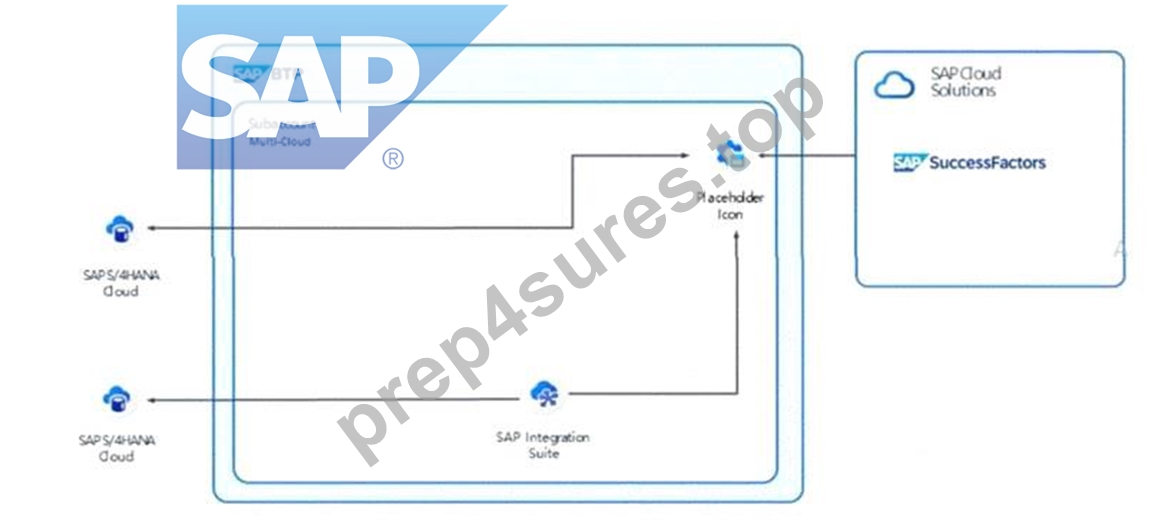
- A. SAP Event Broker
- B. SAP Integration Suite, advanced event mesh
- C. SAP Process Orchestration
- D. SAP Event Mesh
Answer: A,D
Explanation:
SAP Event Broker is part of SAP Integration Suite and provides lightweight event processing for handling scenarios with a limited number of events, as described in the use case.
SAP Event Mesh offers a cloud-native event-driven architecture, enabling applications to communicate asynchronously through events. It integrates with SAP systems like SAP SuccessFactors and supports low- latency webhook triggers.
Both solutions support cloud-first architectures, meeting the customer's preference for a cloud-based event solution.(Reference: SAP Event Mesh Overview)
NEW QUESTION # 23
A project lead has the following requirements for a new design:
*When there is a deficit in the quantity of materials to be delivered by the supplier in a purchase order, an event will be triggered in S/4HANA Cloud by a periodic background job.
*The business event will be sent to SAP Event Mesh. A custom process will then be started in an on-premise system.
*The IT staff will have to set up several different scenarios using different on-premise systems.
The project lead wants an SAP BTP solution that provides guided workflows with assignable tasks to members of the IT staff to help them set up the scenarios.
As the solution architect, which of the following do you recommend?
- A. SAP Build Process Automation
- B. Cloud Integration Automation Service
- C. Intelligent Situation Automation
- D. SAP Automation Pilot
Answer: B
Explanation:
* Cloud Integration Automation Service is designed to help IT staff set up integration scenarios between SAP systems and other solutions. It provides guided workflows and preconfigured templates to simplify the integration process, making it well-suited for complex scenarios involving multiple on- premise systems.
* In this case, where business events from SAP S/4HANA Cloud are sent to SAP Event Mesh, and custom processes are triggered in on-premise systems, Cloud Integration Automation Service can streamline the setup process by automating and guiding the configuration tasks.
* This service allows IT teams to assign tasks, track progress, and ensure all steps are completed correctly, reducing manual effort and errors.
* The flexibility and guidance offered by the service meet the project lead's requirement for managing and setting up multiple scenarios effectively.
(Reference: Cloud Integration Automation Service Documentation)
NEW QUESTION # 24
As a solution architect, you are in a meeting about the design of a new application to manage the delivery process of goods or services. The extension will be maintained by the line of business (as opposed to IT).
The following application parameters/features are discussed:
*Tracking deliveries in real-time
*Optimizing delivery routes
*Providing delivery notifications to customers.
*Scaling according to usage
*Maintenance downtime must be short.
Which extension type is best suited for this application?
- A. Side-by-side
- B. Classic
- C. Key user
Answer: A
Explanation:
A side-by-side extension is best suited for an application that requires:
* Real-time tracking of deliveries.
* Optimization algorithms for delivery routes.
* High scalability and minimal maintenance downtime.
By developing this extension in SAP BTP, it can run independently of the core ERP system, allowing for scaling and agility, which is essential for line-of-business-managed solutions.
Side-by-side extensions leverage cloud services and ensure that maintenance or updates to the extension do not disrupt the core system.
NEW QUESTION # 25
As a solution architect, you are asked for your opinion on an optimal integration. You are told that the data resides in two places, SAP S/4HANA (on- premise) and third party APIs. You are also told the following requirements:
*Periodically read the data from both systems, perform several transformations of the data, and forward the results to a business partner.
*Monitoring is to be done by a dedicated group from IT with SAP products.
*Maintenance of the integration part has a small budget, limited time, and limited resources. Which of the following solutions would you recommend as optimal for the design?
- A. SAP Build Apps and SAP Cloud ALM
- B. SAP Integration Suite and SAP Cloud ALM
- C. A custom SAP Fiori App and Grafana
- D. SAP Build Process Automation and SAP Solution Manager
Answer: B
Explanation:
For the described scenario, SAP Integration Suite and SAP Cloud ALM are optimal because:
* SAP Integration Suite
* It is designed for managing periodic data integrations, transformations, and forwarding to business partners.
* The suite supports multi-system integrations, enabling data exchange between SAP S/4HANA (on-premise) and third-party APIs.
* Built-in tools like Cloud Integration and Integration Advisor allow you to define mappings, transformations, and message flows efficiently with minimal resources and budget.
* SAP Cloud ALM
* This service supports centralized monitoring of integration scenarios, meeting the requirement for IT to oversee the process.
* It provides pre-configured dashboards and alerts to manage and troubleshoot integrations in real time.
This combination ensures minimal maintenance costs and reduced complexity while offering a robust integration and monitoring framework.
References:
* SAP Integration Suite
* SAP Cloud ALM
NEW QUESTION # 26
A manufacturer wants to discuss the design of a solution that tracks and manages stock availability and movement of goods within a warehouse. They want to ensure that movements are aggregated for reporting purposes and that these reports can be used to optimize stock movements. They also want to use the newest solutions to build these reports.
Which of the following solutions can be used together to fulfill the requirements? Note: There are 3 correct answers to this question.
- A. SAP Analytics Cloud
- B. SAP Datasphere
- C. SAP HANA Cloud
- D. SAP HANA Service (SAP Regions) for SAP BTP
- E. SAP Data Intelligence
Answer: A,B,C
NEW QUESTION # 27
The customer is looking to use an SAP BTP service to replicate master data objects across connected business applications. The service should be based off of the process integration style and the integration use case pattern as defined in the SAP Integration Solution Advisory Methodology.
The customer wants to use an SAP BTP service to synchronize the workforce person master data object between SAP S/4HANA Cloud and SAP SuccessFactors HXM Suite as part of the Hire to Retire process (for cloud deployment). They prefer a service that uses a "hub and spoke" model to enable the synchronization.
Which of the following SAP solution should the customer use as the "Placeholder Icon" (see attached diagram)?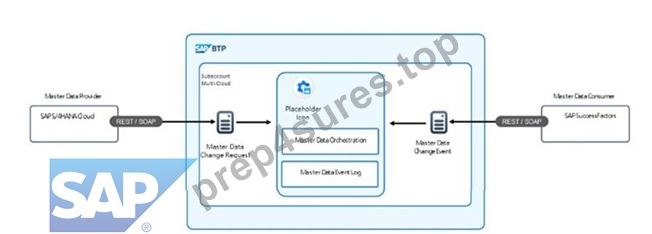
- A. SAP Master Data Governance
- B. SAP Master Data Integration
- C. SAP NetWeaver Master Data Management
- D. SAP Cloud Integration
Answer: B
NEW QUESTION # 28
A customer is asking you to provide a pricing plan given the following parameters:
*Payment annual in advance
*Purchase of additional capacity such as memory or storage without penalty
*Use of additional SAP BTP services without penalty Which pricing plan would you recommend?
- A. Subscription
- B. Trial
- C. Pay-As-You-Go for SAP BTP
- D. SAP BTPEA
Answer: D
Explanation:
The SAP BTP Enterprise Agreement (SAP BTPEA) is the recommended pricing model based on the customer's requirements:
* Key Features of SAP BTPEA:
* Annual Payment in Advance: Customers commit to a defined budget upfront for a 12-month period.
* Purchase of Additional Capacity without Penalty: Additional resources like memory or storage can be purchased seamlessly.
* Use of Additional Services without Penalty: BTPEA allows customers to consume more services as needed, with charges deducted from their committed budget.
* Other Options:
* A (Subscription): Restricts the use of additional services or capacity without predefined terms.
* B (Trial): Does not meet enterprise-scale requirements and lacks flexibility for additional capacity or services.
* D (Pay-As-You-Go): Charges are based on consumption without the advantages of committing upfront or purchasing additional resources penalty-free.
References:
* SAP BTP Pricing Models Overview
NEW QUESTION # 29
The finance department is creating a series of reports for their line of business (LOB) users and would like to integrate the reports in a front-end portal. They would like the LOB users to maintain the portal, as opposed to IT. As a solution architect, they come to you to recommend which SAP BTP service best fits their needs.
Which service would you recommend?
- A. SAP Build Work Zone, advanced edition
- B. SAP Fiori Launchpad
- C. SAP Launchpad Service
- D. SAP Build Work Zone, standard edition
Answer: A
Explanation:
The SAP Build Work Zone, advanced edition is the best fit for the finance department's requirement to integrate reports into a front-end portal and allow Line of Business (LOB) users to maintain the portal.
* Why SAP Build Work Zone, Advanced Edition?
* It provides a flexible, enterprise-grade portal for integrating various business applications and content, such as reports, dashboards, and links.
* Allows LOB users to maintain and customize the portal independently, without relying on IT.
* Supports integration with non-SAP and SAP applications seamlessly, including embedding analytics and reports.
* Other Options:
* A (SAP Launchpad Service): Focused on enabling role-based access to SAP Fiori apps but lacks advanced customization features for LOB users.
* C (SAP Build Work Zone, Standard Edition): Suitable for basic workspaces but lacks advanced capabilities for LOB-driven maintenance.
* D (SAP Fiori Launchpad): Primarily used for launching SAP applications, not for integrating diverse reports or customizing portals.
References:
* SAP Build Work Zone Documentation
NEW QUESTION # 30
A client's IT department has half a dozen subaccounts. They are having problems with the administration of the subaccounts as well as the corresponding global account.
Which SAP BTP service would you recommend to the customer, to design and develop a custom application to perform their administrative tasks?
- A. SAP Cloud Management service for SAP BTP
- B. SAP Monitoring service for SAP BTP
- C. SAP Custom Domain service
- D. SAP Audit Log service
Answer: A
NEW QUESTION # 31
In which phase of the SAP Integration Solution Advisory Methodology is a technology mapping of customer use cases and SAP BTP integration services produced (for an example of a solution architecture blueprint, see the attached diagram)?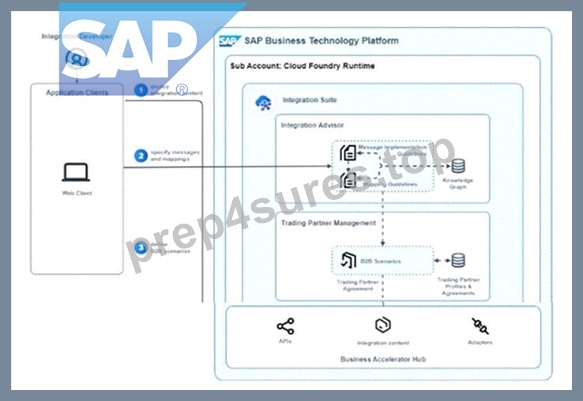
- A. Design your hybrid integration platform
- B. Assess your integration strategy
- C. Enable a practice of empowerment
- D. Define integration best practices
Answer: A
Explanation:
The technology mapping of customer use cases and SAP BTP integration services is produced during the
"Design your hybrid integration platform" phase of the SAP Integration Solution Advisory Methodology (ISA- M). This phase focuses on aligning customer-specific integration scenarios with the available integration capabilities provided by SAP Business Technology Platform (BTP).
Key activities in this phase include:
* Mapping Use Cases to SAP BTP Services:This involves evaluating the customer's integration requirements and determining how they align with the integration services offered by SAP BTP (e.g., SAP Integration Suite, APIs, or event-driven services). For example, in the attached diagram, integration services such as the Integration Advisor, Trading Partner Management, and APIs are mapped to specific customer needs.
* Defining Solution Architecture Blueprints:Based on the mapped use cases, solution architects create integration blueprints that guide the technical implementation. These blueprints show how components like message mappings, B2B scenarios, and runtime environments in SAP BTP can be used effectively.
* Hybrid Integration Strategy:This phase also emphasizes designing an architecture that supports both cloud and on-premise integrations, leveraging the capabilities of SAP BTP.
* SAP Integration Solution Advisory Methodology (ISA-M): The ISA-M framework defines the "Design your hybrid integration platform" phase as the stage where organizations formalize their technical architecture by combining customer use cases with SAP BTP services.
* SAP Integration Suite Guide: This guide outlines the use of Integration Suite components like Integration Advisor and Trading Partner Management, which are referenced in the diagram.
* Solution Architecture Methodology: This course details how to produce solution architecture blueprints as part of integration platform design.
SAP Documentation References:This phase (option C) is critical for ensuring that customer requirements are implemented using the best practices and services offered by SAP BTP.
NEW QUESTION # 32
You are a solution architect and your client needs help in choosing the appropriate SAP solution to use for their application design. #
* SAP SuccessFactors will trigger an "event" when employees complete a variety of tasks such as changing their address or updating their W-4 information.
* The event will be caught by one of SAP's event solutions and it will trigger (via webhook) either SAP Integration Suite or SAP S/4HANA Cloud as needed.
* The number of events processed is not expected to be high.
* A cloud solution is preferred.
Which of the following could be used in place of the "Placeholder Icon" in the attached diagram? Note: There are 2 correct answers to this question.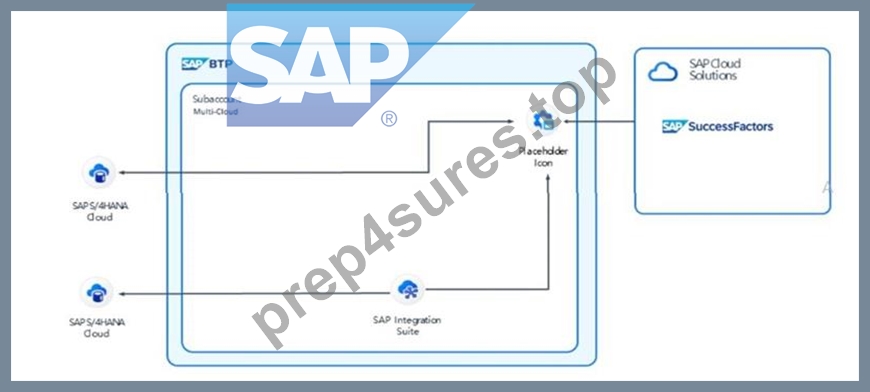
- A. SAP Event Broker
- B. SAP Integration Suite, advanced event mesh
- C. SAP Process Orchestration
- D. SAP Event Mesh
Answer: A,D
NEW QUESTION # 33
A company is implementing SAP S/4HANA Cloud along with SAP BTP. They need a customer-facing application for the general public. The application also needs to use its own unique SAP BTP subdomain. As a solution architect, you have been asked how a unique domain name can be accomplished.
Which of the following can serve as an option? Note: There are 2 correct answers to this question.
- A. Create a new domain using the SAP Custom Domain Service
- B. Create a new domain in a new directory
- C. Create a new domain in a new subaccount
- D. Create a new domain in a new global account
Answer: A,C
Explanation:
* Create a New Domain in a New Subaccount (B):
* Each subaccount in SAP BTP can have its own unique domain.
* By creating a new subaccount, the customer can define a subdomain specific to the customer- facing application.
* SAP Custom Domain Service (C):
* Allows customers to map their applications to custom domains for branding purposes.
* Ensures the customer-facing app can use a unique, user-defined domain name.
* Why Not Other Options?
* A (New Global Account): Creating a new global account is unnecessary for achieving a unique domain and incurs additional administrative overhead.
* D (New Directory): Directories are organizational units in SAP BTP and do not support domain customization directly.
References:
* SAP Custom Domain Service
NEW QUESTION # 34
The following design (see attached diagram) uses third-party REST APIs that are publicly available through the internet.
Which capability of the SAP Integration Suite can be used in place of "1" in the diagram?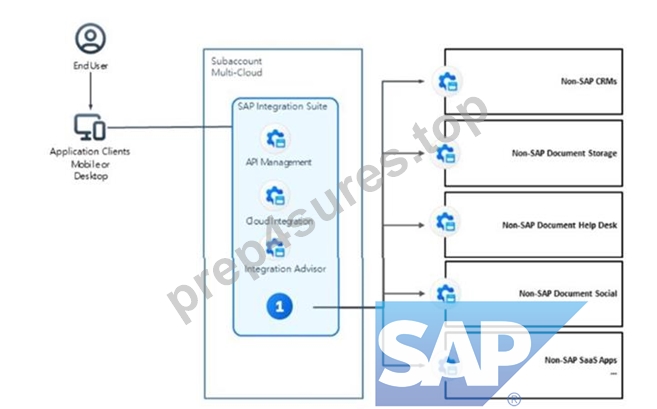
- A. SAP Connectivity Service
- B. SAP Open Connectors
- C. SAP Business Connector
- D. SAP Cloud Connector
Answer: B
NEW QUESTION # 35
A company is decommissioning its legacy ERP system in favor of adopting SAP solutions. The company is not sure which specific solutions to adopt. The company has three main business goals:
* Maintain several unique business processes.
* Maintain the solutions with a small budget, and limited time and resources.
* Integrate several non-SAP solutions.
Which combination of solutions should the customer adopt?
- A. SAP Signavio | SAP S/4HANA Cloud public edition | SAP BTP
- B. SAP Signavio | SAP S/4HANA public edition | SAP Process Orchestration
- C. SAP Lean IX | SAP S/4HANA Cloud private edition | SAP Process Orchestration
- D. SAP Lean IX | SAP S/4HANA on premise | SAP BTP
Answer: A
NEW QUESTION # 36
You are a solution architect assigned to a customer business transformation project.
Which solutions would you recommend the customers adopt to analyze and to optimize their procurement process to exceed industry benchmarks? Note: There are 2 correct answers to this question.
- A. SAP Signavio Process Transformation Manager
- B. SAP Signavio Process Manager
- C. SAP Signavio Value Accelerators
- D. SAP Signavio Process Intelligence
Answer: A,D
NEW QUESTION # 37
According to the attached diagram, which SAP Integration Suite capability can a customer use to monetize their APIs? Note: There are 2 correct answers to this question.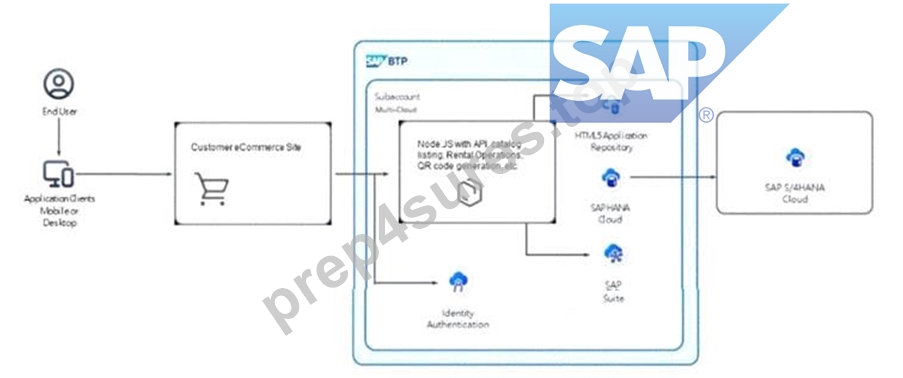
- A. SAP API Management
- B. SAP Business Accelerator Hub
- C. SAP API Business Hub Enterprise
- D. SAP Market Rates Management, Bring Your Own Rates data option
Answer: A,C
Explanation:
SAP API Business Hub Enterprise: Provides a central repository for discovering, accessing, and monetizing APIs. Businesses can use this capability to offer their APIs for consumption, either internally or externally, with monitoring and monetization features.
SAP API Management: Allows for managing the complete API lifecycle, including monetization, by enabling metering, usage tracking, and setting up API monetization models. This is key for businesses aiming to generate revenue from their APIs while ensuring secure and scalable operations.(Reference: SAP Integration Suite - API Management)
NEW QUESTION # 38
A customer's sales department is having problems with governmental authorities dealing with transparency around logging events related to security and other compliance topics.
As an SAP Solution Architect, which SAP BTP service would you recommend for being compliant with regulations?
- A. SAP Application Logging service for SAP BTP
- B. SAP Cloud Logging service
- C. SAP Cloud Management service for SAP BTP
- D. SAP Audit Log service
Answer: D
NEW QUESTION # 39
A customer is struggling with organizing and managing the immense amount of data generated by the business. They have been told about several possible solutions that SAP BTP offers; however, they are confused about which solutions they should use. Their data is highly structured and includes customers, sales orders, and purchase orders. The data needs to be stored for both transactional and reporting purposes in a vector database. The client prefers to use the latest SAP solutions.
Which of the following SAP BTP solutions would you recommend?
- A. SAP HANA Cloud
- B. SAP HANA Cloud, data lake
- C. SAP Datasphere
- D. SAP Analytics Cloud
Answer: A
NEW QUESTION # 40
Which of the following are process steps in serving up a model in SAP AI Core? Note: There are 2 correct answers to this question.
- A. Prepare the data
- B. Register the Input Dataset
- C. Make an inference
- D. Create an Al Launchpad instance
Answer: C,D
NEW QUESTION # 41
A customer has developed an application. This application crashes occasionally. They want to collect metrics and traces to fix the problems that cause the application to crash. They are particularly impressed with the OpenSearch specification from Apache and would like to use an SAP BTP solution based on it, if one is available.
Which SAP BTP services would you recommend? Note: There are 2 correct answers to this question.
- A. SAP Cloud Management service for SAP BTP
- B. SAP Cloud Logging service
- C. SAP Application Logging service for SAP BTP
- D. SAP Audit Log service
Answer: B,C
Explanation:
SAP Application Logging service for SAP BTP: Offers the ability to collect, store, and query logs for debugging and troubleshooting purposes. It is ideal for understanding application issues.
SAP Cloud Logging service: Built on the OpenSearch framework, this service provides advanced logging capabilities, including metrics and trace collection, that align with the OpenSearch specification the customer prefers.
Both services allow developers to monitor their applications effectively and resolve crashes by analyzing logs and traces.(Reference: SAP Cloud Logging Service)
NEW QUESTION # 42
You are a solution architect assigned to a customer business transformation project.
Which solutions would you recommend the customers adopt to analyze and to optimize their procurement process to exceed industry benchmarks? Note: There are 2 correct answers to this question.
- A. SAP Signavio Process Transformation Manager
- B. SAP Signavio Process Manager
- C. SAP Signavio Value Accelerators
- D. SAP Signavio Process Intelligence
Answer: A,D
Explanation:
SAP Signavio Process Transformation Manager: Enables organizations to analyze and optimize end-to- end procurement processes by identifying inefficiencies and providing insights into how processes can be redesigned to exceed industry benchmarks.
SAP Signavio Process Intelligence: Provides advanced process mining and analysis capabilities, allowing customers to understand current performance, uncover bottlenecks, and identify optimization opportunities in procurement processes.
Together, these tools provide a robust foundation for driving process excellence and achieving better-than- industry benchmarks in procurement.(Reference: SAP Signavio Documentation)
NEW QUESTION # 43
......
SAP P-BTPA-2408 Exam Syllabus Topics:
| Topic | Details |
|---|---|
| Topic 1 |
|
| Topic 2 |
|
| Topic 3 |
|
SAP P-BTPA-2408 Official Cert Guide PDF: https://freedownload.prep4sures.top/P-BTPA-2408-real-sheets.html