


Prepare For Realistic OGEA-103 Dumps PDF - 100% Passing Guarantee
Check the Available OGEA-103 Exam Dumps with 122 Q's
NEW QUESTION # 39
Exhibit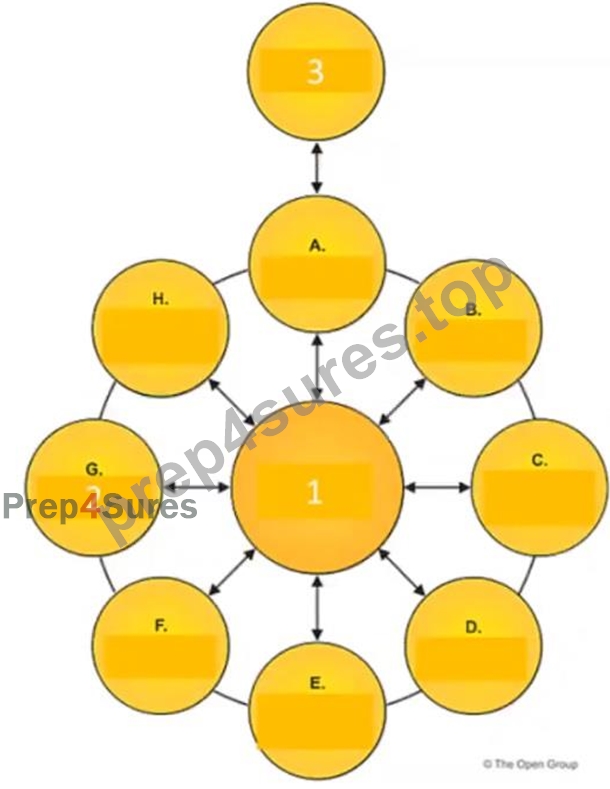
Consider the illustration showing an architecture development cycle Which description matches the phase of the ADM labeled as item 1?
- A. Provides architectural oversight for the implementation
- B. Conducts implementation planning for the architecture defined in previous phases
- C. Establishes procedures for managing change to the new architecture
- D. Operates the process of managing architecture requirements
Answer: D
Explanation:
The illustration shows an architecture development cycle based on the TOGAF ADM (Architecture Development Method), which is a method for developing and managing an enterprise architecture1.
The ADM consists of nine phases, each with a specific purpose and output. The phases are1:
Preliminary Phase: To prepare and initiate the architecture development cycle, including defining the architecture framework, principles, and governance.
Phase A: Architecture Vision: To define the scope, vision, and stakeholders of the architecture initiative, and to obtain approval to proceed.
Phase B: Business Architecture: To describe the baseline and target business architecture, and to identify the gaps between them.
Phase C: Information Systems Architectures: To describe the baseline and target data and application architectures, and to identify the gaps between them.
Phase D: Technology Architecture: To describe the baseline and target technology architecture, and to identify the gaps between them.
Phase E: Opportunities and Solutions: To identify and evaluate the opportunities and solutions for implementing the target architecture, and to define the work packages and transition architectures.
Phase F: Migration Planning: To finalize the implementation and migration plan, and to ensure alignment with the enterprise portfolio and project management.
Phase G: Implementation Governance: To provide architecture oversight and guidance for the implementation projects, and to manage any architecture change requests.
Phase H: Architecture Change Management: To monitor the changes in the business and technology environment, and to assess the impact and performance of the architecture.
In addition to these phases, there is a central process called Requirements Management, which is labeled as item 1 in the illustration. This process operates throughout the ADM cycle, and its purpose is to manage the architecture requirements throughout the architecture development, ensuring that they are aligned with the business requirements and the stakeholder concerns2.
Therefore, the description that matches the phase of the ADM labeled as item 1 is C. Operates the process of managing architecture requirements.
Reference:
1: The TOGAF Standard, Version 9.2, Chapter 5: Architecture Development Method (ADM)
2: The TOGAF Standard, Version 9.2, Chapter 17: Requirements Management
NEW QUESTION # 40
Consider the image showing basic architectural concepts.
What are items A and B?
- A. A-Architecture Board, B-Architecture Capability
- B. A-Candidate Architecture, B-Trade-off
- C. A-Requirement. B-Candidate Architecture
- D. A-Architecture Viewpoint, B-Architecture View
Answer: D
Explanation:
The image shows a diagram that illustrates the basic concepts of architecture description as defined by the ISO/IEC/IEEE 42010:2011 standard1, which is also adopted by the TOGAF standard2.
According to the ISO/IEC/IEEE 42010:2011 standard, an architecture description is a work product used to express an architecture, and it consists of one or more architecture views1.
An architecture view is a representation of a system from the perspective of a related set of concerns, and it conforms to an architecture viewpoint1.
An architecture viewpoint is a specification of the conventions for constructing and using an architecture view to address specific stakeholder concerns1.
Therefore, the correct answer is option A, which identifies the items labeled as "A" and "B" in the image as an architecture viewpoint and an architecture view, respectively. Reference:
1: ISO/IEC/IEEE 42010:2011 - Systems and software engineering - Architecture description1
2: TOGAF Standard, Version 9.2 - Part IV: Architecture Content Framework - 31. Architectural Artifacts2
NEW QUESTION # 41
Complete the sentence. Actions arising from the Business Transformation Readiness Assessment technique should be incorporated in the
- A. Architecture Requirements Specification
- B. Implementation and Migration Plan
- C. Implementation Governance Model
- D. Architecture Roadmap
Answer: B
Explanation:
The Business Transformation Readiness Assessment technique is used to evaluate the readiness of the organization to undergo change and to identify the actions needed to increase the likelihood of a successful business transformation. These actions should be incorporated in the Implementation and Migration Plan, which is the detailed plan to transition from the Baseline Architecture to the Target Architecture. The Implementation and Migration Plan also includes the Transition Architectures, the Architecture Building Blocks, the Work Packages, the Implementation Governance Model, and the Architecture Contract12 References: 1: The TOGAF Standard, Version 9.2, Part III: ADM Guidelines and Techniques, Chapter 27: Business Transformation Readiness Assessment 2: The TOGAF Standard, Version 9.2, Part II:
Architecture Development Method (ADM), Chapter 21: Phase F: Migration Planning
NEW QUESTION # 42
What are the four dimensions used to scope an architecture?
- A. Strategy Segment Capability Budget
- B. Breadth Depth Time Period Architecture Domains
- C. Business Data Application Technology
- D. Strategy Portfolio Project Solution Delivery
Answer: B
Explanation:
The four dimensions used to scope an architecture are Breadth, Depth, Time Period, and Architecture Domains1, p. 8.
Breadth refers to the extent of the enterprise covered by the architecture, which can range from a specific business unit to the entire organization1, p. 8.
Depth refers to the level of detail and completeness of the architecture, which can vary depending on the purpose, scope, and stakeholders of the architecture1, p. 8.
Time Period refers to the temporal aspects of the architecture, such as the current state, the target state, and the transition plan1, p. 8.
Architecture Domains refers to the classification of the architecture into four domains: Business, Data, Application, and Technology1, p. 8.
These four dimensions help define the scope and boundaries of the architecture and ensure that it meets the needs and expectations of the stakeholders.
1: The Open Group (2018). The TOGAFStandard, Version 9.2. 1
NEW QUESTION # 43
You are working as an Enterprise Architect at a large company. The company runs many retail stores as well as an online marketplace that allows hundreds of brands to partner with the company. The company has a mature Enterprise Architecture (EA) practice and uses the TOGAF standard for its architecture development method. The EA practice is involved in all aspects of the business, with oversight provided by an Architecture Board with representatives from different parts of the business. The EA program is sponsored by the Chief Information Officer (CIO).
Many of the stores remain open all day and night. Each store uses a standard method to track sales and inventory, which involves sending accurate, timely sales data to a central AI-based inventory management system that can predict demand, adjust stock levels, and automate reordering. The central inventory management system is housed at the company's central data center.
The company has acquired a major rival. The Chief Executive Officer (CEO) believes that the merger will enable growth through combined offerings and cost savings. The decision has been made to fully integrate the two organizations, including merging retail operations and systems. Duplicated systems will be replaced with one standard retail management system. The CIO expects significant savings from these changes across the newly merged company.
The rival company has successfully implemented the use of hand-held devices within stores for both customers and staff, which has increased satisfaction due to time savings. The CIO has approved the rollout of these devices to all stores but has stated that training should be brief, as there are many part-time employees.
You have been asked to confirm the most relevant architecture principles for this transformation. Based on the TOGAF Standard, which of the following is the best answer?
- A. Control Technical Diversity, Interoperability, Data is an Asset, Data is Shared, Business Continuity
- B. Common Use Applications, Data is an Asset, Data is Accessible, Ease of Use, Business Continuity
- C. Maximize Benefit to the Enterprise, Common Use Applications, Data is an Asset, Responsive Change Management, Technology Independence
- D. Common Vocabulary and Data Definitions, Compliance with the Law, Requirements Based Change, Responsive Change Management, Data Security
Answer: C
Explanation:
In this scenario, the enterprise is undergoing significant transformation due to a merger and the adoption of new technology (hand-held devices). Several key principles from TOGAF's ADM Techniques-particularly those focused on promoting enterprise-wide standardization, adaptability, and data utilization-are pertinent here:
Maximize Benefit to the Enterprise:
This principle emphasizes that all architectural decisions should deliver maximum business value. Given that the company is integrating systems to cut costs and improve offerings, maximizing the benefit is crucial. Ensuring that the EA efforts align with enterprise-wide benefits supports the goal of optimizing costs and enhancing offerings, which aligns with the CEO's vision for the merger.
Common Use Applications:
Standardizing applications across the merged entity will be essential to achieve cost savings and to simplify operations. The goal of reducing the number of applications fits with this principle, ensuring that reusable and widely adopted applications support business functions across the organization. Adopting this principle will also aid in harmonizing the systems from both organizations and avoiding unnecessary diversity.
Data is an Asset:
Data plays a central role in the company's operations, especially with the use of AI-driven inventory management and the integration of systems. Treating data as an asset is essential for reliable and accurate decision-making. This principle ensures that data is viewed as a critical enterprise resource and is managed with care, maintaining integrity, accuracy, and value.
Responsive Change Management:
The organization's ability to adapt quickly and effectively to changes, such as integrating new handheld devices and merging systems, is essential. This principle will facilitate the smooth transition required for integrating the new handheld devices and the merger-related system updates while minimizing disruption to store operations.
Technology Independence:
Since the enterprise will likely encounter varied technologies from the merger, it is crucial to maintain flexibility. This principle advocates for using technology solutions that are adaptable and not bound to a single vendor or specific technology. This ensures that the enterprise can integrate various technological components from both organizations and evolve with minimal constraints.
These principles align well with TOGAF's broader recommendations for guiding architectural changes, as found in Section 2.6 of the TOGAF ADM Techniques. They ensure that the EA practice is aligned with business objectives while maintaining flexibility, data integrity, and a focus on enterprise-wide benefits. These guiding principles are critical for the successful execution of the integration and adoption of new technologies while achieving cost efficiencies and improving service delivery.
For reference, TOGAF's ADM Techniques highlight the importance of architectural principles in guiding transformational initiatives, ensuring that decisions are made consistently across the enterprise. Each principle supports organizational agility, system integration, and the efficient use of technology resources, all of which are vital for the enterprise's stated objectives.
NEW QUESTION # 44
Please read this scenario prior to answering the question
You are working as an Enterprise Architect within a healthcare and life science company. The company is a leading player in its industry, dedicated to transforming healthcare with new ideas and advancements. The company has multiple divisions that cover different aspects of the business.
The company's Enterprise Architecture (EA) department has been operating for several years and has mature, well-developed architecture governance and development processes following the TOGAF Standard. In addition to the EA program, the company has a number of management frameworks in use.
The Architecture Board includes representatives from each division of the company.
Many of the company's rivals have begun utilizing Artificial Intelligence (Al) in their operations, and the indications are that this will be transformative for healthcare delivery. This is something the EA department has been interested in for a while, and they had recently submitted an architecture Change Request which was approved. As a result, the CIO has approved a Request for Architecture Work to investigate the implementation of Al in the company.
Areas for evaluation include:
How can staff use Al daily in their current role?
How Al can enhance access to care for patients, and how to make that experience seamless?
How Al can offer new workplace platforms and tools to increase efficiency?
Some of the top managers are worried about a change in the way of working, and if it will achieve the goals.
Many are not confident that the company's risk management processes are adequate for a company-wide integration of generative Al. There are also questions from staff about whether enough specific guidelines and polices have been put in place for responsible use of Al.
The Chief Information Officer (CIO) is the sponsor of the Enterprise Architecture program. The CIO has actively encouraged architecting with agility within the EA department as her preferred approach for projects.
The CIO wants to know how to address these concerns and reduce risks.
Refer to the scenario
You have been tasked with starting the architecture development. How do you begin?
Based on the TOGAF standard which of the following is the best answer?
- A. You recommend that a Communications Plan be created to address the key stakeholders, that is themost powerful and influential partners. This plan should include a report that summarizes the keyfeatures of the architecture with respect to each location and reflects the stakeholders' requirements.You will check with each key stakeholder that their concerns are being addressed. Risk mitigationshould be explicitly addressed as a component of the architecture being developed.
- B. You recommend that an analysis of the stakeholders is undertaken. This will allow the architects todefine groups of partners (the stakeholders) who have common concerns and include developmentof a Stakeholder Map. The concerns and relevant views should then be defined for each group andrecorded in the Architecture Vision document. To mitigate risk, you include a requirement that therebe progressive development of the target architecture to ensure there is regular feedback.
- C. You recommend creation of a set of business models that can be applied uniformly across all Al-related architecture projects. These should be developed in the portable format to ensure maximumportability across the many tools used in the firm. Each architecture should then be defined based onthis fixed set of models. All concerned parties can then examine the models to ensure that theirneeds have been addressed.
- D. You recommend that models be created for the Draft Business, Data, Application, and TechnologyArchitectures. These can be used to ensure that the system will be compliant with the localregulations for each division. Together with the problem description, and requirements, this ensuresthat all the necessary data and detail is addressed. A formal review should be held with thestakeholders to verify that their concerns have been properly addressed by the models.
Answer: B
Explanation:
Key aspects of the scenario:
Objective:
Integrating Artificial Intelligence (AI) into healthcare delivery, with a focus on improving patient care, enhancing workplace efficiency, and enabling seamless experiences.
Challenges:
Stakeholder concerns about risk management, adaptability to change, and ensuring alignment with regulations and policies.
Addressing the concerns of staff and top management about AI integration and achieving the desired goals.
CIO's Perspective:
Encouraging an agile approach to architecture development.
Addressing risks and ensuring stakeholder concerns are managed.
Areas for Evaluation:
AI usage by staff and impact on workflows.
Patient experience enhancement via AI.
New workplace platforms and tools powered by AI.
Option Analysis:
Option 1: Analysis of stakeholders and development of a Stakeholder Map Pros:
Stakeholder analysis is critical for identifying concerns, viewpoints, and requirements.
TOGAF emphasizes stakeholder engagement early in the process to mitigate risks and align expectations.
Developing a Stakeholder Map ensures clear alignment with their interests and creates a foundation for regular feedback loops.
Cons:
Does not explicitly address the creation of architecture models or policies upfront.
Option 2: Creation of a Communications Plan
Pros:
A communications plan fosters effective stakeholder engagement by addressing their concerns and ensuring transparent reporting.
Risk mitigation as part of communication aligns with TOGAF's stakeholder management practices.
Cons:
This focuses more on communication mechanics rather than advancing architectural development directly.
Option 3: Models for Draft Business, Data, Application, and Technology Architectures Pros:
Aligns with the Architecture Development Method (ADM), ensuring compliance with requirements and regulations.
Helps formalize stakeholder feedback by verifying their concerns against tangible models.
Cons:
Developing detailed models early on may delay immediate resolution of stakeholder concerns and risk mitigation.
Option 4: Set of reusable business models for AI-related projects
Pros:
Standardized models ensure consistency and portability across the organization's AI-related efforts.
Cons:
Too narrow in focus for the initial architecture development phase; does not address risk management or stakeholder concerns adequately.
Recommended answer:
Option 1: You recommend that an analysis of the stakeholders is undertaken.
Reasoning:
The scenario highlights stakeholder concerns about risks, adaptability, and compliance. Addressing these concerns requires stakeholder analysis as the first step.
A Stakeholder Map aligns with TOGAF's emphasis on stakeholder engagement, providing a structured way to manage their concerns and expectations.
Identifying concerns early and integrating feedback into the Architecture Vision document ensures alignment with goals and smooth progress.
Option 1 sets the foundation for collaboration and risk management, making it the best fit for the current phase.
NEW QUESTION # 45
Consider the following ADM phases objectives.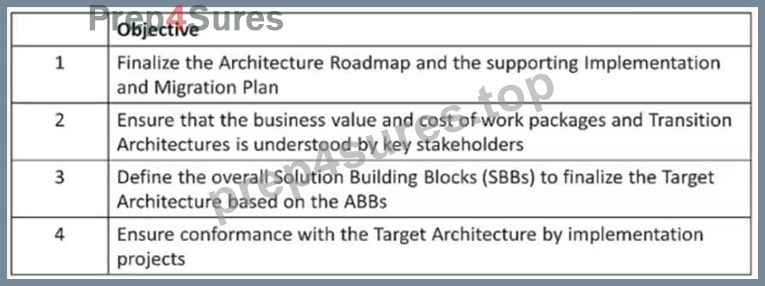
Which phase does each objective match?
- A. 1E-2F-3E-4G
- B. 1F-2G-3F-4F
- C. 1F-2F-3E-4G
- D. 1G-2E-3F-4E
Answer: A
Explanation:
Explanation
1E: To identify delivery vehicles (projects programs portfolios) that will deliver the Target Architecture 2F:
To confirm readiness and ability to undergo change 3E: To determine whether an incremental approach is required and if so identify Transition Architectures that will deliver continuous business value 4G: To perform appropriate governance functions while the solution is being implemented Reference: The TOGAF Standard | The Open Group Website, Section 3.2 ADM Phases.
NEW QUESTION # 46
Please read this scenario prior to answering the question
You have been appointed as Chief Enterprise Architect (CEA). reporting to the Chief Technical Officer (CTO), of a company established as a separate operating entity by a major automotive manufacturer. The mission of the company is to build a new industry leading unified technology and software platform for electric vehicles.
The company uses the TOGAF Standard as the basis for its Enterprise Architecture (EA) framework, and architecture development follows the purpose-based EA Capability model as described in the TOGAF Series Guide: A Practitioners'Approach to Developing Enterprise Architecture Following the TOGAF ADM.
An end-to-end Target Architecture has been completed with a roadmap for change over a five-year period. The new platform will be a cross-functional effort between hardware and software teams, with significant changes over the old platform. It is expected to be developed in several stages over three years. The EA team has inherited the architecture for the previous generation hardware and software automotive platform, some of which can be carried over to the new unified platform. The EA team has started to define the new platform, including defining which parts of the architecture to carry forward.
Enough of the Business Architecture has been defined, so that work can commence on the Information Systems and Technology Architectures. Those need to be defined to support the core business services that the company plans to provide. The core services will feature an innovative approach with swarm data generated by vehicles, paving the way for autonomous driving in the future.
The presentation and access to different variations of data that the company plans to offer through its platform pose an architecture challenge. The application portfolio and supporting infrastructure need to interact with various existing cloud services and data- Refer to the scenario You have been asked what approach should be taken to determine and organize the work to deliver the requested architectures?
Based on the TOGAF standard which of the following is the best answer?
- A. You will research leading data businesses, developing high-level Target Data, Application and Technology Architectures. You would review the Architecture Vision in order to estimate the level of detail, time, and breadth of the ADM cycle phases that will be needed to develop the architecture. You will identify and cost major work packages, and then develop an Architecture Roadmap. You would then seek approval by the Architecture Board and initiate the project.
- B. You would refer to the end-to-end Target Architecture for guidance and direction. The first objective should be to identify projects, dependencies and synergies, then prioritize before initiating the projects.
You will develop high-level architecture descriptions. For each project you would estimate effort size, identify reference architectures, and candidate building blocks. You will identify the resource needs considering cost and value. You will document options, risks, and controls to enable viability analysis and trade-off with the stakeholders. - C. You would look outside the enterprise to research data models and application portfolios of leading big data businesses. You would develop just enough applications, data, and technology architecture to identify options. For each project this should include identification of candidate architecture and solution building blocks. You will identify solution providers, perform a readiness assessment, and assess the viability and fitness of the solution options. You will then document the draft Implementation and Migration plan.
- D. You will revisit ADM Phase A. identifying the stakeholders and creating a new Architecture Vision.
You will update the Stakeholder map produced for the strategic architecture so it reflects the stakeholders who are now the most relevant to the projects that are to be developed. You would then ask the CTO to make some decisions about the Architecture Roadmap, and update the Implementation and Migration Plan to reflect the decisions.
Answer: B
Explanation:
The Target Architecture is a description of the future state of the architecture that addresses the business goals and drivers, and satisfies the stakeholder requirements and concerns. The Target Architecture is developed through the Architecture Development Method (ADM), which is the core process of the TOGAF standard that guides the development and management of the enterprise architecture. The Target Architecture is typically divided into four domains: Business, Data, Application, and Technology. The Target Architecture also includes a roadmap for change, which defines the Transition Architectures, the Capability Increments, and the work packages that enable the transition from the Baseline Architecture to the Target Architecture12 The best answer is B, because it describes the approach that should be taken to determine and organize the work to deliver the requested architectures, which are the Information Systems and Technology Architectures.
The answer covers the following steps:
* Refer to the end-to-end Target Architecture for guidance and direction. The end-to-end Target Architecture provides the overall vision, scope, and objectives of the architecture work, and the alignment with the business strategy and goals. The end-to-end Target Architecture also provides the high-level definitions and principles for the four architecture domains, and the roadmap for change that outlines the major milestones and deliverables.
* Identify projects, dependencies and synergies, then prioritize before initiating the projects. Projects are the units of work that implement the architecture work packages, which are the sets of actions or tasks that are required to implement a specific part of the architecture. Dependencies are the relationships and
* constraints that affect the order or priority of the projects, such as logical, temporal, or resource dependencies. Synergies are the benefits or advantages that result from the combination or coordination of the projects, such as cost savings, efficiency gains, or innovation opportunities. Prioritization is the process of ranking the projects according to their importance, urgency, or value, and assigning resources and schedules accordingly.
* Develop high-level architecture descriptions. High-level architecture descriptions are the outputs of the architecture development phases (B, C, and D) of the ADM cycle, which describe the Business, Data, Application, and Technology Architectures in terms of the Architecture Building Blocks (ABBs) and the Solution Building Blocks (SBBs), which are reusable components of business, IT, or architectural capability. High-level architecture descriptions also include the Architecture Views, which are representations of the system of interest from the perspective of one or more stakeholders and their concerns.
* For each project, estimate effort size, identify reference architectures, and candidate building blocks.
Effort size is the measure of the amount of work, time, or resources required to complete a project.
Effort size can be estimated using various techniques, such as analogy, expert judgment, parametric, or bottom-up. Reference architectures are standardized architectures that provide a common framework and vocabulary for a specific domain or industry. Reference architectures can be used as a source of best practices, patterns, and models for the architecture development. Candidate building blocks are the potential ABBs or SBBs that can be used to implement the architecture. Candidate building blocks can be identified from the Architecture Repository, which is a collection of architecture assets, such as models, patterns, principles, standards, and guidelines.
* Identify the resource needs considering cost and value. Resource needs are the specifications and criteria that define the acceptable level and quality of the resources required to complete the project, such as human, financial, physical, or technological resources. Resource needs can be identified by analyzing the scope, complexity, and dependencies of the project, and the availability, capability, and suitability of the resources. Cost and value are the factors that influence the allocation and utilization of the resources, such as the budget, the return on investment, the benefits, or the risks.
* Document options, risks, and controls to enable viability analysis and trade-off with the stakeholders.
Options are the alternative ways of achieving the project objectives, such as different solutions, technologies, vendors, or approaches. Risks are the effects of uncertainty on the project objectives, such as threats or opportunities. Controls are the measures or actions that are taken to prevent, reduce, or mitigate the risks, such as policies, procedures, or standards. Viability analysis is the process of evaluating and comparing the options, risks, and controls, and determining the feasibility, suitability, and desirability of each option. Trade-off is the decision outcome that balances and reconciles the multiple, often conflicting, requirements and concerns of the stakeholders, and ensures alignment with the Architecture Vision and the Architecture Principles.
References: 1: The TOGAF Standard, Version 9.2, Part II: Architecture Development Method (ADM), Chapter 5: Introduction to the ADM 2: The TOGAF Standard, Version 9.2, Part IV: Architecture Content Framework, Chapter 36: Building Blocks : The TOGAF Standard, Version 9.2, Part II: Architecture Development Method (ADM), Chapter 18: Phase A: Architecture Vision : The TOGAF Standard, Version 9.2, Part II: Architecture Development Method (ADM), Chapter 19: Phase B: Business Architecture : The TOGAF Standard, Version 9.2, Part II: Architecture Development Method (ADM), Chapter 20: Phase C: Information Systems Architectures : The TOGAF Standard, Version 9.2, Part II: Architecture Development Method (ADM), Chapter 21: Phase F: Migration Planning : The TOGAF Standard, Version 9.2, Part III: ADM Guidelines and Techniques, Chapter 23: Architecture Principles : The TOGAF Standard, Version 9.2, Part III:
ADM Guidelines and Techniques, Chapter 30: Trade-Off Analysis : The TOGAF Standard, Version 9.2, Part VI: Architecture Capability Framework, Chapter 46: Tools for Architecture Development : The TOGAF Standard, Version 9.2, Part VI: Architecture Capability Framework, Chapter 47: Architecture Board : The TOGAF Standard, Version 9.2, Part VI: Architecture Capability Framework, Chapter 48: Architecture Compliance : The TOGAF Standard, Version 9.2, Part VI: Architecture Capability Framework, Chapter 49:
Architecture Contract : The TOGAF Standard, Version 9.2, Part VI: Architecture Capability Framework, Chapter 50: Architecture Governance : The TOGAF Standard, Version 9.2, Part VI: Architecture Capability Framework, Chapter 51: Architecture Maturity Models : The TOGAF Standard, Version 9.2, Part VI:
Architecture Capability Framework, Chapter 52: Architecture Skills Framework
NEW QUESTION # 47
When considering the scope of an architecture, what dimension considers to what level of detail the architecting effort should go?
- A. Breadth
- B. Project
- C. Depth
- D. Architecture Domains
Answer: C
Explanation:
The scope of an architecture is the extent and level of detail of the architecture work. The scope of an architecture can be defined along four dimensions: project, breadth, depth, and architecture domains. The project dimension considers the boundaries and objectives of the architecture project, such as the time frame, budget, resources, and deliverables. The breadth dimension considers the coverage and completeness of the architecture across the enterprise, such as the organizational units, business functions, processes, and locations.
The depth dimension considers the level of detail and specificity of the architecture, such as the granularity, abstraction, and precision of the architectural elements and relationships. The architecture domains dimension considers the aspects or segments of the architecture, such as the business, data, application, and technology domains.
Therefore, the depth dimension is the one that considers to what level of detail the architecting effort should go.
References: : The TOGAF Standard, Version 9.2, Part III: ADM Guidelines and Techniques, Chapter 25:
Architecture Scope : The TOGAF Standard, Version 9.2, Part III: ADM Guidelines and Techniques, Chapter
25.2: Scope Dimensions : The TOGAF Standard, Version 9.2, Part III: ADM Guidelines and Techniques, Chapter 25.2.1: Project, Breadth, Depth, and Architecture Domains
NEW QUESTION # 48
Consider the illustration.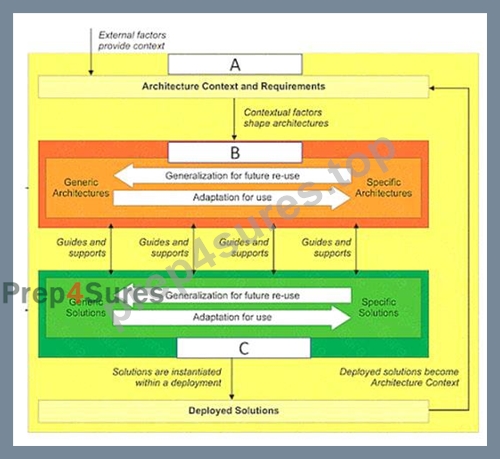
What are the items labelled A, B and C?
- A. A-Architecture Vision, B-Business Architecture, C-Information Systems Architecture
- B. A-Enterprise Continuum, B-Architecture Continuum, C-Solutions Continuum
- C. A-Enterprise Architecture, B-Architecture Building Blocks, C-Solutions Building Blocks
- D. A-Enterprise Strategic Architecture, B-Segment Architecture, C-Solutions Architecture
Answer: B
Explanation:
The illustration shows the relationship between the Enterprise Continuum, the Architecture Continuum, and the Solutions Continuum, which are key concepts in the TOGAF framework. The Enterprise Continuum is a view of the Architecture Repository that shows how generic foundation architectures can be leveraged and specialized to support the requirements of an individual organization. The Architecture Continuum specifies a structured classification for architectural artifacts, such as models, patterns, and descriptions, that can be reused and adapted across different domains and levels of abstraction. The Solutions Continuum identifies implemented solutions that support various stages of business and IT capability evolution, such as common systems, industry solutions, and organization-specific solutions. The illustration also shows how the architecture context and requirements are influenced by external factors, such as business drivers, stakeholders, and standards, and how they shape the generic and specific architectures and solutions. The illustration also shows how the deployed solutions become part of the architecture context for future iterations of the architecture development cycle. References:
*TOGAF Standard, 10th Edition, Part II: Architecture Development Method, Chapter 6: Architecture Repository, Section 6.2 Enterprise Continuum.
*TOGAF Standard, 10th Edition, Part IV: Architecture Content Framework, Chapter 35: Enterprise Continuum and Tools, Section 35.1 Introduction.
NEW QUESTION # 49
Refer to the table below:
Which ADM Phase does this describe?
- A. Phase E
- B. Phase G
- C. Phase F
- D. Phase A
Answer: C
Explanation:
The description provided aligns with Phase F: Migration Planning in the TOGAF ADM. This phase focuses on finalizing and implementing the projects necessary to reach the adjusted target state.
* Phase F Objective:
* Ensures projects and work packages are well-defined and align with stakeholder priorities.
* Translates architecture changes into actionable implementation projects.
* Assesses risk, value, and effort in implementation.
* Establishes the Implementation and Migration Plan.
* Key Outputs of Phase F:
* Architecture Roadmap (Updated)
* Implementation and Migration Plan
* Governance Model for Change Implementation
* Why Other Options Are Incorrect:
* Option A (Phase E: Opportunities & Solutions): Focuses on defining projects and high-level solutions, but does not complete their implementation planning.
* Option B (Phase A: Architecture Vision): Establishes high-level goals but does not involve migration planning.
* Option C (Phase G: Implementation Governance): Ensures the execution aligns with architecture, but does not define projects for migration.
Reference:
TOGAF Standard, 10th Edition - Part II: Architecture Development Method, Chapter 19 (Phase F: Migration Planning).
NEW QUESTION # 50
Which of the following describes a purpose of Architecture Principles?
- A. To provide a better understanding about the enterprise's culture and values
- B. To establish a common understanding of how to control the business in pursuit of strategic objectives
- C. To form a contract between sponsoring organization and the enterprise architects
- D. To describe likely impacts resulting from successful deployment of the target architecture.
Answer: B
Explanation:
Architecture Principles are general rules and guidelines that inform and support the way in which an organization sets about fulfilling its mission. They reflect a level of consensus among the various elements of the enterprise, and form the basis for making future IT decisions. One of the purposes of Architecture Principles is to establish a common understanding of how to control the business in pursuit of strategic objectives, by providing a framework for evaluating and agreeing on the changes that affect the enterprise's architecture3 References: 3: The TOGAF Standard, Version 9.2, Part III: ADM Guidelines and Techniques, Chapter 23: Architecture Principles : The TOGAF Standard, Version 9.2, Part IV: Architecture Content Framework, Chapter 31: Architecture Principles
NEW QUESTION # 51
What are the four dimensions used to scope an architecture?
- A. Strategy Segment Capability Budget
- B. Breadth Depth Time Period Architecture Domains
- C. Business Data Application Technology
- D. Strategy Portfolio Project Solution Delivery
Answer: B
Explanation:
The four dimensions used to scope an architecture are Breadth, Depth, Time Period, and Architecture Domains1, p. 8.
Breadth refers to the extent of the enterprise covered by the architecture, which can range from a specific business unit to the entire organization1, p. 8.
Depth refers to the level of detail and completeness of the architecture, which can vary depending on the purpose, scope, and stakeholders of the architecture1, p. 8.
Time Period refers to the temporal aspects of the architecture, such as the current state, the target state, and the transition plan1, p. 8.
Architecture Domains refers to the classification of the architecture into four domains: Business, Data, Application, and Technology1, p. 8.
These four dimensions help define the scope and boundaries of the architecture and ensure that it meets the needs and expectations of the stakeholders.
References:
1: The Open Group (2018). The TOGAF® Standard, Version 9.2. 1
NEW QUESTION # 52
Exhibit: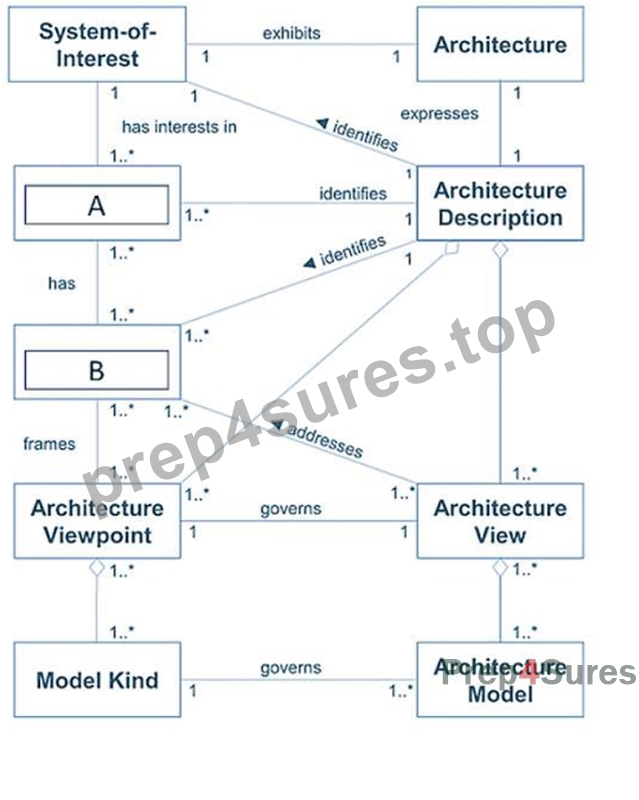
Consider the image showing basic architectural concepts.
What are items A and B?
- A. A-User, B-Requirement
- B. A-Base Architecture, B-Target Architecture
- C. A-Candidate Architecture, B-Trade-off
- D. A-Stakeholder, B-Concern
Answer: D
Explanation:
In the context of TOGAF, a stakeholder is any individual, team, or organization who has interests in, or concerns relative to, the outcome of the architecture. Concerns are those interests which pertain to any aspect of the system's functioning, development or operation, including considerations such as performance, reliability, and security1. References:
*The TOGAF Standard, Version 9.2 - Definitions - The Open Group
NEW QUESTION # 53
Which of the following best describes a purpose of the Gap Analysis technique?
- A. To establish quality metrics for the architecture
- B. To validate non-functional requirements
- C. To determine service levels for the architecture
- D. To identify missing functions
Answer: D
Explanation:
Explanation
Gap analysis is a technique that is used to validate an architecture by highlighting the shortfall between the Baseline Architecture and the Target Architecture. One of the purposes of gap analysis is to identify missing functions that are either deliberately omitted, accidentally left out, or not yet defined in the Target Architecture. Missing functions are marked as gaps that need to be filled by developing or procuring the building blocks.
NEW QUESTION # 54
......
Download OGEA-103 Exam Dumps Questions to get 100% Success: https://freedownload.prep4sures.top/OGEA-103-real-sheets.html