


[Sep 25, 2025] Fully Updated Dumps PDF - Latest Professional-Machine-Learning-Engineer Exam Questions and Answers
100% Free Professional-Machine-Learning-Engineer Exam Dumps to Pass Exam Easily from Prep4sures
Career Bonuses
The Google Professional Machine Learning Engineer certification proves that the successful candidates possess sufficient knowledge and skills to design and create scalable solutions for optimal performance. Some of the job roles that these individuals can consider include a Data Engineer, a Senior Data Engineer, a Machine Learning Engineer, a Technical Solutions Engineer, a Software Engineer, and a Cloud Infrastructure Engineer, among others. The median salary that the certificate holders can count on is around $140,000 per annum.
NEW QUESTION # 20
You work for a retailer that sells clothes to customers around the world. You have been tasked with ensuring that ML models are built in a secure manner. Specifically, you need to protect sensitive customer data that might be used in the models. You have identified four fields containing sensitive data that are being used by your data science team: AGE, IS_EXISTING_CUSTOMER, LATITUDE_LONGITUDE, and SHIRT_SIZE. What should you do with the data before it is made available to the data science team for training purposes?
- A. Coarsen the data by putting AGE into quantiles and rounding LATITUDE_LONGTTUDE into single precision. The other two fields are already as coarse as possible.
- B. Use principal component analysis (PCA) to reduce the four sensitive fields to one PCA vector.
- C. Remove all sensitive data fields, and ask the data science team to build their models using non-sensitive data.
- D. Tokenize all of the fields using hashed dummy values to replace the real values.
Answer: D
NEW QUESTION # 21
Your company needs to generate product summaries for vendors. You evaluated a foundation model from Model Garden for text summarization but found that the summaries do not align with your company's brand voice. How should you improve this LLM-based summarization model to better meet your business objectives?
- A. Replace the pre-trained model with another model in Model Garden.
- B. Increase the model's temperature parameter.
- C. Tune the token output limit in the response.
- D. Fine-tune the model using a company-specific dataset.
Answer: D
Explanation:
Fine-tuning the model with a company-specific dataset aligns the model outputs with the brand voice, making it better suited for the company's objectives. Adjusting the temperature (Option A) affects randomness rather than content style, and changing token limits (Option C) does not impact tone. Replacing the model (Option D) is inefficient without guarantees of better alignment.
NEW QUESTION # 22
You work for a retail company that is using a regression model built with BigQuery ML to predict product sales. This model is being used to serve online predictions Recently you developed a new version of the model that uses a different architecture (custom model) Initial analysis revealed that both models are performing as expected You want to deploy the new version of the model to production and monitor the performance over the next two months You need to minimize the impact to the existing and future model users How should you deploy the model?
- A. Deploy the new model to a separate Vertex Al endpoint Create a Cloud Run service that routes the prediction requests to the corresponding endpoints based on the input feature values.
- B. Import the new model to the same Vertex Al Model Registry as a different version of the existing model. Deploy the new model to the same Vertex Al endpoint as the existing model, and use traffic splitting to route 95% of production traffic to the BigQuery ML model and 5% of production traffic to the new model.
- C. Import the new model to the same Vertex Al Model Registry as the existing model Deploy the models to one Vertex Al endpoint Route 95% of production traffic to the BigQuery ML model and 5% of production traffic to the new model
- D. Import the new model to the same Vertex Al Model Registry as the existing model Deploy each model to a separate Vertex Al endpoint.
Answer: B
Explanation:
Vertex AI Model Registry is a central repository where you can manage the lifecycle of your ML models1. You can import models from various sources, such as BigQuery ML, AutoML, or custom models, and assign them to different versions and aliases1. You can also deploy models to endpoints, which are resources that provide a service URL for online prediction2.
By importing the new model to the same Vertex AI Model Registry as a different version of the existing model, you can keep track of the model versions and compare their performance metrics1. You can also use aliases to label the model versions according to their readiness for production, such as default or staging1.
By deploying the new model to the same Vertex AI endpoint as the existing model, you can use traffic splitting to gradually shift the production traffic from the old model to the new model2. Traffic splitting is a feature that allows you to specify the percentage of prediction requests that each deployed model in an endpoint should handle2. This way, you can minimize the impact to the existing and future model users, and monitor the performance of the new model over time2.
The other options are not suitable for your scenario, because they either require creating a separate endpoint or a Cloud Run service, which would increase the complexity and maintenance of your deployment, or they do not allow you to use traffic splitting, which would create a sudden change in your prediction results.
References:
* Introduction to Vertex AI Model Registry | Google Cloud
* Deploy a model to an endpoint | Vertex AI | Google Cloud
NEW QUESTION # 23
You want to migrate a scikrt-learn classifier model to TensorFlow. You plan to train the TensorFlow classifier model using the same training set that was used to train the scikit-learn model and then compare the performances using a common test set. You want to use the Vertex Al Python SDK to manually log the evaluation metrics of each model and compare them based on their F1 scores and confusion matrices. How should you log the metrics?
- A.

- B.

- C.

- D.

Answer: B
Explanation:
To log the metrics of a machine learning model in TensorFlow using the Vertex AI Python SDK, you should utilize the aiplatform.log_metrics function to log the F1 score and aiplatform.
log_classification_metrics function to log the confusion matrix. These functions allow users to manually record and store evaluation metrics for each model, facilitating an efficient comparison based on specific performance indicators like F1 scores and confusion matrices. References: The answer can be verified from official Google Cloud documentation and resources related to Vertex AI and TensorFlow.
* Vertex AI Python SDK reference | Google Cloud
* Logging custom metrics | Vertex AI
* Migrating from scikit-learn to TensorFlow | TensorFlow
NEW QUESTION # 24
You work at a mobile gaming startup that creates online multiplayer games Recently, your company observed an increase in players cheating in the games, leading to a loss of revenue and a poor user experience. You built a binary classification model to determine whether a player cheated after a completed game session, and then send a message to other downstream systems to ban the player that cheated Your model has performed well during testing, and you now need to deploy the model to production You want your serving solution to provide immediate classifications after a completed game session to avoid further loss of revenue. What should you do?
- A. Save the model files in a VM Load the model files each time there is a prediction request and run an inference job on the VM.
- B. Import the model into Vertex Al Model Registry Create a Vertex Al endpoint that hosts the model and make online inference requests.
- C. Import the model into Vertex Al Model Registry. Use the Vertex Batch Prediction service to run batch inference jobs.
- D. Save the model files in a Cloud Storage Bucket Create a Cloud Function to read the model files and make online inference requests on the Cloud Function.
Answer: B
NEW QUESTION # 25
You received a training-serving skew alert from a Vertex Al Model Monitoring job running in production. You retrained the model with more recent training data, and deployed it back to the Vertex Al endpoint but you are still receiving the same alert. What should you do?
- A. Update the model monitoring job to use a lower sampling rate.
- B. Update the model monitoring job to use the more recent training data that was used to retrain the model.
- C. Temporarily disable the alert Enable the alert again after a sufficient amount of new production traffic has passed through the Vertex Al endpoint.
- D. Temporarily disable the alert until the model can be retrained again on newer training data Retrain the model again after a sufficient amount of new production traffic has passed through the Vertex Al endpoint
Answer: B
Explanation:
The best option for resolving the training-serving skew alert is to update the model monitoring job to use the more recent training data that was used to retrain the model. This option can help align the baseline distribution of the model monitoring job with the current distribution of the production data, and eliminate the false positive alerts. Model Monitoring is a service that can track and compare the results of multiple machine learning runs. Model Monitoring can monitor the model's prediction input data for feature skew and drift. Training-serving skew occurs when the feature data distribution in production deviates from the feature data distribution used to train the model. If the original training data is available, you can enable skew detection to monitor your models for training-serving skew. Model Monitoring uses TensorFlow Data Validation (TFDV) to calculate the distributions and distance scores for each feature, and compares them with a baseline distribution. The baseline distribution is the statistical distribution of the feature's values in the training data. If the distance score for a feature exceeds an alerting threshold that you set, Model Monitoring sends you an email alert. However, if you retrain the model with more recent training data, and deploy it back to the Vertex AI endpoint, the baseline distribution of the model monitoring job may become outdated and inconsistent with the current distribution of the production data. This can cause the model monitoring job to generate false positive alerts, even if the model performance is not deteriorated. To avoid this problem, you need to update the model monitoring job to use the more recent training data that was used to retrain the model. This can help the model monitoring job to recalculate the baseline distribution and the distance scores, and compare them with the current distribution of the production data. This can also help the model monitoring job to detect any true positive alerts, such as a sudden change in the production data that causes the model performance to degrade1.
The other options are not as good as option B, for the following reasons:
Option A: Updating the model monitoring job to use a lower sampling rate would not resolve the training-serving skew alert, and could reduce the accuracy and reliability of the model monitoring job. The sampling rate is a parameter that determines the percentage of prediction requests that are logged and analyzed by the model monitoring job. Using a lower sampling rate can reduce the storage and computation costs of the model monitoring job, but also the quality and validity of the data. Using a lower sampling rate can introduce sampling bias and noise into the data, and make the model monitoring job miss some important features or patterns of the data. Moreover, using a lower sampling rate would not address the root cause of the training-serving skew alert, which is the mismatch between the baseline distribution and the current distribution of the production data2.
Option C: Temporarily disabling the alert, and enabling the alert again after a sufficient amount of new production traffic has passed through the Vertex AI endpoint, would not resolve the training-serving skew alert, and could expose the model to potential risks and errors. Disabling the alert would stop the model monitoring job from sending email notifications when the distance score for a feature exceeds the alerting threshold, but it would not stop the model monitoring job from calculating and comparing the distributions and distance scores. Therefore, disabling the alert would not address the root cause of the training-serving skew alert, which is the mismatch between the baseline distribution and the current distribution of the production data. Moreover, disabling the alert would prevent the model monitoring job from detecting any true positive alerts, such as a sudden change in the production data that causes the model performance to degrade. This can expose the model to potential risks and errors, and affect the user satisfaction and trust1.
Option D: Temporarily disabling the alert until the model can be retrained again on newer training data, and retraining the model again after a sufficient amount of new production traffic has passed through the Vertex AI endpoint, would not resolve the training-serving skew alert, and could cause unnecessary costs and efforts. Disabling the alert would stop the model monitoring job from sending email notifications when the distance score for a feature exceeds the alerting threshold, but it would not stop the model monitoring job from calculating and comparing the distributions and distance scores. Therefore, disabling the alert would not address the root cause of the training-serving skew alert, which is the mismatch between the baseline distribution and the current distribution of the production data. Moreover, disabling the alert would prevent the model monitoring job from detecting any true positive alerts, such as a sudden change in the production data that causes the model performance to degrade. This can expose the model to potential risks and errors, and affect the user satisfaction and trust. Retraining the model again on newer training data would create a new model version, but it would not update the model monitoring job to use the newer training data as the baseline distribution. Therefore, retraining the model again on newer training data would not resolve the training-serving skew alert, and could cause unnecessary costs and efforts1.
Reference:
Preparing for Google Cloud Certification: Machine Learning Engineer, Course 3: Production ML Systems, Week 4: Evaluation Google Cloud Professional Machine Learning Engineer Exam Guide, Section 3: Scaling ML models in production, 3.3 Monitoring ML models in production Official Google Cloud Certified Professional Machine Learning Engineer Study Guide, Chapter 6: Production ML Systems, Section 6.3: Monitoring ML Models Using Model Monitoring Understanding the score threshold slider Sampling rate
NEW QUESTION # 26
You are training an LSTM-based model on Al Platform to summarize text using the following job submission script: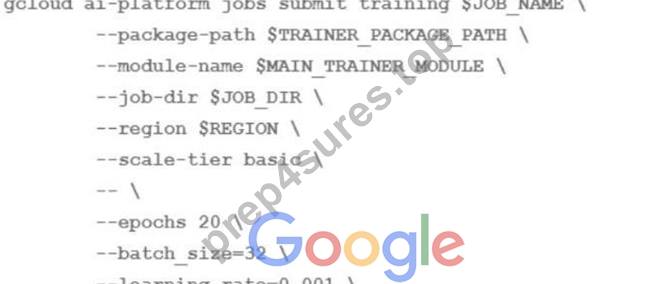
You want to ensure that training time is minimized without significantly compromising the accuracy of your model. What should you do?
- A. Modify the batch size' parameter
- B. Modify the 'learning rate' parameter
- C. Modify the 'epochs' parameter
- D. Modify the 'scale-tier' parameter
Answer: D
Explanation:
The training time of a machine learning model depends on several factors, such as the complexity of the model, the size of the data, the hardware resources, and the hyperparameters. To minimize the training time without significantly compromising the accuracy of the model, one should optimize these factors as much as possible.
One of the factors that can have a significant impact on the training time is the scale-tier parameter, which specifies the type and number of machines to use for the training job on AI Platform. The scale-tier parameter can be one of the predefined values, such as BASIC, STANDARD_1, PREMIUM_1, or BASIC_GPU, or a custom value that allows you to configure the machine type, the number of workers, and the number of parameter servers1 To speed up the training of an LSTM-based model on AI Platform, one should modify the scale-tier parameter to use a higher tier or a custom configuration that provides more computational resources, such as more CPUs, GPUs, or TPUs. This can reduce the training time by increasing the parallelism and throughput of the model training. However, one should also consider the trade-off between the training time and the cost, as higher tiers or custom configurations may incur higher charges2 The other options are not as effective or may have adverse effects on the model accuracy. Modifying the epochs parameter, which specifies the number of times the model sees the entire dataset, may reduce the training time, but also affect the model's convergence and performance. Modifying the batch size parameter, which specifies the number of examples per batch, may affect the model's stability and generalization ability, as well as the memory usage and the gradient update frequency. Modifying the learning rate parameter, which specifies the step size of the gradient descent optimization, may affect the model's convergence and performance, as well as the risk of overshooting or getting stuck in local minima3 References: 1: Using predefined machine types 2: Distributed training 3: Hyperparameter tuning overview
NEW QUESTION # 27
You work for a magazine publisher and have been tasked with predicting whether customers will cancel their annual subscription. In your exploratory data analysis, you find that 90% of individuals renew their subscription every year, and only 10% of individuals cancel their subscription. After training a NN Classifier, your model predicts those who cancel their subscription with 99% accuracy and predicts those who renew their subscription with 82% accuracy. How should you interpret these results?
- A. This is a good result because predicting those who cancel their subscription is more difficult, since there is less data for this group.
- B. This is not a good result because the model is performing worse than predicting that people will always renew their subscription.
- C. This is a good result because the accuracy across both groups is greater than 80%.
- D. This is not a good result because the model should have a higher accuracy for those who renew their subscription than for those who cancel their subscription.
Answer: A
NEW QUESTION # 28
You need to deploy a scikit-learn classification model to production. The model must be able to serve requests 24/7 and you expect millions of requests per second to the production application from 8 am to 7 pm. You need to minimize the cost of deployment What should you do?
- A. Deploy an online Vertex Al prediction endpoint with one GPU per replica Set the max replica count to 100.
- B. Deploy an online Vertex Al prediction endpoint with one GPU per replica Set the max replica count to 1.
- C. Deploy an online Vertex Al prediction endpoint Set the max replica count to 100
- D. Deploy an online Vertex Al prediction endpoint Set the max replica count to 1
Answer: B
NEW QUESTION # 29
You work at a bank You have a custom tabular ML model that was provided by the bank's vendor. The training data is not available due to its sensitivity. The model is packaged as a Vertex Al Model serving container which accepts a string as input for each prediction instance. In each string the feature values are separated by commas. You want to deploy this model to production for online predictions, and monitor the feature distribution over time with minimal effort What should you do?
- A. 1 Upload the model to Vertex Al Model Registry and deploy the model to a Vertex Al endpoint.
2 Create a Vertex Al Model Monitoring job with feature skew detection as the monitoring objective and provide an instance schema. - B. 1 Refactor the serving container to accept key-value pairs as input format.
2. Upload the model to Vertex Al Model Registry and deploy the model to a Vertex Al endpoint.
3. Create a Vertex Al Model Monitoring job with feature drift detection as the monitoring objective. - C. 1 Upload the model to Vertex Al Model Registry and deploy the model to a Vertex Ai endpoint.
2. Create a Vertex Al Model Monitoring job with feature drift detection as the monitoring objective, and provide an instance schema. - D. 1 Refactor the serving container to accept key-value pairs as input format.
2 Upload the model to Vertex Al Model Registry and deploy the model to a Vertex Al endpoint.
3. Create a Vertex Al Model Monitoring job with feature skew detection as the monitoring objective.
Answer: B
NEW QUESTION # 30
You are implementing a batch inference ML pipeline in Google Cloud. The model was developed using TensorFlow and is stored in SavedModel format in Cloud Storage You need to apply the model to a historical dataset containing 10 TB of data that is stored in a BigQuery table How should you perform the inference?
- A. Import the TensorFlow model by using the create model statement in BigQuery ML Apply the historical data to the TensorFlow model.
- B. Configure a Vertex Al batch prediction job to apply the model to the historical data in BigQuery
- C. Export the historical data to Cloud Storage in Avro format. Configure a Vertex Al batch prediction job to generate predictions for the exported data.
- D. Export the historical data to Cloud Storage in CSV format Configure a Vertex Al batch prediction job to generate predictions for the exported data.
Answer: B
Explanation:
The best option for implementing a batch inference ML pipeline in Google Cloud, using a model that was developed using TensorFlow and is stored in SavedModel format in Cloud Storage, and a historical dataset containing 10 TB of data that is stored in a BigQuery table, is to configure a Vertex AI batch prediction job to apply the model to the historical data in BigQuery. This option allows you to leverage the power and simplicity of Vertex AI and BigQuery to perform large-scale batch inference with minimal code and configuration. Vertex AI is a unified platform for building and deploying machine learning solutions on Google Cloud. Vertex AI can run a batch prediction job, which can generate predictions for a large number of instances in batches. Vertex AI can also provide various tools and services for data analysis, model development, model deployment, model monitoring, and model governance. A batch prediction job is a resource that can run your model code on Vertex AI. A batch prediction job can help you generate predictions for a large number of instances in batches, and store the prediction results in a destination of your choice. A batch prediction job can accept various input formats, such as JSON, CSV, or TFRecord. A batch prediction job can also accept various input sources, such as Cloud Storage or BigQuery. A TensorFlow model is a resource that represents a machine learning model that is built using TensorFlow. TensorFlow is a framework that can perform large-scale data processing and machine learning. TensorFlow can help you build and train various types of models, such as linear regression, logistic regression, k-means clustering, matrix factorization, and deep neural networks. A SavedModel format is a type of format that can store a TensorFlow model and its associated assets. A SavedModel format can help you save and load your TensorFlow model, and serve it for prediction. A SavedModel format can be stored in Cloud Storage, which is a service that can store and access large-scale data on Google Cloud. A historical dataset is a collection of data that contains historical information about a certain domain. A historical dataset can help you analyze the past trends and patterns of the data, and make predictions for the future. A historical dataset can be stored in BigQuery, which is a service that can store and query large-scale data on Google Cloud. BigQuery can help you analyze your data by using SQL queries, and perform various tasks, such as data exploration, data transformation, or data visualization. By configuring a Vertex AI batch prediction job to apply the model to the historical data in BigQuery, you can implement a batch inference ML pipeline in Google Cloud with minimal code and configuration. You can use the Vertex AI API or the gcloud command-line tool to configure a batch prediction job, and provide the model name, the model version, the input source, the input format, the output destination, and the output format. Vertex AI will automatically run the batch prediction job, and apply the model to the historical data in BigQuery. Vertex AI will also store the prediction results in a destination of your choice, such as Cloud Storage or BigQuery1.
The other options are not as good as option D, for the following reasons:
Option A: Exporting the historical data to Cloud Storage in Avro format, configuring a Vertex AI batch prediction job to generate predictions for the exported data would require more skills and steps than configuring a Vertex AI batch prediction job to apply the model to the historical data in BigQuery, and could increase the complexity and cost of the batch inference process. Avro is a type of format that can store and serialize data in a binary format. Avro can help you compress and encode your data, and support schema evolution and compatibility. By exporting the historical data to Cloud Storage in Avro format, configuring a Vertex AI batch prediction job to generate predictions for the exported data, you can perform batch inference with minimal code and configuration. You can use the BigQuery API or the bq command-line tool to export the historical data to Cloud Storage in Avro format, and use the Vertex AI API or the gcloud command-line tool to configure a batch prediction job, and provide the model name, the model version, the input source, the input format, the output destination, and the output format. However, exporting the historical data to Cloud Storage in Avro format, configuring a Vertex AI batch prediction job to generate predictions for the exported data would require more skills and steps than configuring a Vertex AI batch prediction job to apply the model to the historical data in BigQuery, and could increase the complexity and cost of the batch inference process. You would need to write code, export the historical data to Cloud Storage, configure a batch prediction job, and generate predictions for the exported data. Moreover, this option would not use BigQuery as the input source for the batch prediction job, which can simplify the batch inference process, and provide various benefits, such as fast query performance, serverless scaling, and cost optimization2.
Option B: Importing the TensorFlow model by using the create model statement in BigQuery ML, applying the historical data to the TensorFlow model would not allow you to use Vertex AI to run the batch prediction job, and could increase the complexity and cost of the batch inference process. BigQuery ML is a feature of BigQuery that can create and execute machine learning models in BigQuery by using SQL queries. BigQuery ML can help you build and train various types of models, such as linear regression, logistic regression, k-means clustering, matrix factorization, and deep neural networks. A create model statement is a type of SQL statement that can create a machine learning model in BigQuery ML. A create model statement can help you specify the model name, the model type, the model options, and the model query. By importing the TensorFlow model by using the create model statement in BigQuery ML, applying the historical data to the TensorFlow model, you can perform batch inference with minimal code and configuration. You can use the BigQuery API or the bq command-line tool to import the TensorFlow model by using the create model statement in BigQuery ML, and provide the model name, the model type, the model options, and the model query. You can also use the BigQuery API or the bq command-line tool to apply the historical data to the TensorFlow model, and provide the model name, the input data, and the output destination. However, importing the TensorFlow model by using the create model statement in BigQuery ML, applying the historical data to the TensorFlow model would not allow you to use Vertex AI to run the batch prediction job, and could increase the complexity and cost of the batch inference process. You would need to write code, import the TensorFlow model, apply the historical data, and generate predictions. Moreover, this option would not use Vertex AI, which is a unified platform for building and deploying machine learning solutions on Google Cloud, and provide various tools and services for data analysis, model development, model deployment, model monitoring, and model governance3.
Option C: Exporting the historical data to Cloud Storage in CSV format, configuring a Vertex AI batch prediction job to generate predictions for the exported data would require more skills and steps than configuring a Vertex AI batch prediction job to apply the model to the historical data in BigQuery, and could increase the complexity and cost of the batch inference process. CSV is a type of format that can store and serialize data in a comma-separated values format. CSV can help you store and exchange your data, and support various data types and formats. By exporting the historical data to Cloud Storage in CSV format, configuring a Vertex AI batch prediction job to generate predictions for the exported data, you can perform batch inference with minimal code and configuration. You can use the BigQuery API or the bq command-line tool to export the historical data to Cloud Storage in CSV format, and use the Vertex AI API or the gcloud command-line tool to configure a batch prediction job, and provide the model name, the model version, the input source, the input format, the output destination, and the output format. However, exporting the historical data to Cloud Storage in CSV format, configuring a Vertex AI batch prediction job to generate predictions for the exported data would require more skills and steps than configuring a Vertex AI batch prediction job to apply the model to the historical data in BigQuery, and could increase the complexity and cost of the batch inference process. You would need to write code, export the historical data to Cloud Storage, configure a batch prediction job, and generate predictions for the exported data. Moreover, this option would not use BigQuery as the input source for the batch prediction job, which can simplify the batch inference process, and provide various benefits, such as fast query performance, serverless scaling, and cost optimization2.
Reference:
Batch prediction | Vertex AI | Google Cloud
Exporting table data | BigQuery | Google Cloud
Creating and using models | BigQuery ML | Google Cloud
NEW QUESTION # 31
You work for a manufacturing company. You need to train a custom image classification model to detect product defects at the end of an assembly line Although your model is performing well some images in your holdout set are consistently mislabeled with high confidence You want to use Vertex Al to understand your model's results What should you do?
- A.

- B.

- C.

- D.

Answer: C
Explanation:
Vertex Explainable AI is a set of tools and frameworks to help you understand and interpret predictions made by your machine learning models, natively integrated with a number of Google's products and services1. With Vertex Explainable AI, you can generate feature-based explanations that show how much each input feature contributed to the model's prediction2. This can help you debug and improve your model performance, and build confidence in your model's behavior. Feature-based explanations are supported for custom image classification models deployed on Vertex AI Prediction3. References:
* Explainable AI | Google Cloud
* Introduction to Vertex Explainable AI | Vertex AI | Google Cloud
* Supported model types for feature-based explanations | Vertex AI | Google Cloud
NEW QUESTION # 32
You are designing an architecture with a serverless ML system to enrich customer support tickets with informative metadata before they are routed to a support agent. You need a set of models to predict ticket priority, predict ticket resolution time, and perform sentiment analysis to help agents make strategic decisions when they process support requests. Tickets are not expected to have any domain-specific terms or jargon.
The proposed architecture has the following flow: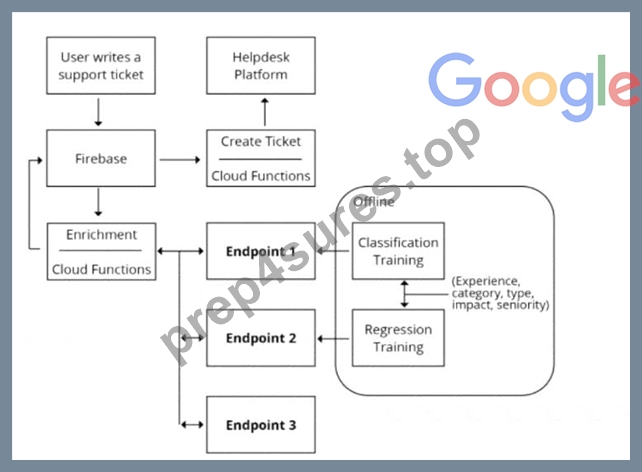
Which endpoints should the Enrichment Cloud Functions call?
- A. 1 = Vertex Al. 2 = Vertex Al. 3 = AutoML Vision
- B. 1 = Cloud Natural Language API. 2 = Vertex Al, 3 = Cloud Vision API
- C. 1 = Vertex Al. 2 = Vertex Al. 3 = Cloud Natural Language API
- D. 1 = Vertex Al. 2 = Vertex Al. 3 = AutoML Natural Language
Answer: C
Explanation:
Vertex AI is a unified platform for building and deploying ML models on Google Cloud. It supports both custom and AutoML models, and provides various tools and services for ML development, such as Vertex Pipelines, Vertex Vizier, Vertex Explainable AI, and Vertex Feature Store. Vertex AI can be used to create models for predicting ticket priority and resolution time, as these are domain-specific tasks that require custom training data and evaluation metrics. Cloud Natural Language API is a pre-trained service that provides natural language understanding capabilities, such as sentiment analysis, entity analysis, syntax analysis, and content classification. Cloud Natural Language API can be used to perform sentiment analysis on the support tickets, as this is a general task that does not require domain-specific knowledge or jargon. The other options are not suitable for the given architecture. AutoML Natural Language and AutoML Vision are services that allow users to create custom natural language and vision models using their own data and labels. They are not needed for sentiment analysis, as Cloud Natural Language API already provides this functionality. Cloud Vision API is a pre-trained service that provides image analysis capabilities, such as object detection, face detection, text detection, and image labeling. It is not relevant for the support tickets, as they are not expected to have any images. References:
* Vertex AI documentation
* Cloud Natural Language API documentation
NEW QUESTION # 33
You are developing a model to predict whether a failure will occur in a critical machine part. You have a dataset consisting of a multivariate time series and labels indicating whether the machine part failed You recently started experimenting with a few different preprocessing and modeling approaches in a Vertex Al Workbench notebook. You want to log data and track artifacts from each run. How should you set up your experiments?
- A.

- B.

- C.

- D.

Answer: B
NEW QUESTION # 34
You have recently trained a scikit-learn model that you plan to deploy on Vertex Al. This model will support both online and batch prediction. You need to preprocess input data for model inference. You want to package the model for deployment while minimizing additional code What should you do?
- A. 1 Create a custom container for your sci-kit learn model.
2 Upload your model and custom container to Vertex Al Model Registry
3 Deploy your model to Vertex Al Endpoints, and create a Vertex Al batch prediction job that uses the instanceConfig. instanceType setting to transform your input data - B. 1. Create a custom container for your sci-kit learn model,
2 Define a custom serving function for your model
3 Upload your model and custom container to Vertex Al Model Registry
4 Deploy your model to Vertex Al Endpoints, and create a Vertex Al batch prediction job - C. 1 Wrap your model in a custom prediction routine (CPR). and build a container image from the CPR local model
2 Upload your sci-kit learn model container to Vertex Al Model Registry
3 Deploy your model to Vertex Al Endpoints, and create a Vertex Al batch prediction job - D. 1 Upload your model to the Vertex Al Model Registry by using a prebuilt scikit-learn prediction container
2 Deploy your model to Vertex Al Endpoints, and create a Vertex Al batch prediction job that uses the instanceConfig.inscanceType setting to transform your input data
Answer: C
Explanation:
The best option for deploying a scikit-learn model on Vertex AI with minimal additional code is to wrap the model in a custom prediction routine (CPR) and build a container image from the CPR local model. Upload your scikit-learn model container to Vertex AI Model Registry. Deploy your model to Vertex AI Endpoints, and create a Vertex AI batch prediction job. This option allows you to leverage the power and simplicity of Google Cloud to deploy and serve a scikit-learn model that supports both online and batch prediction. Vertex AI is a unified platform for building and deploying machine learning solutions on Google Cloud. Vertex AI can deploy a trained scikit-learn model to an online prediction endpoint, which can provide low-latency predictions for individual instances. Vertex AI can also create a batch prediction job, which can provide high-throughput predictions for a large batch of instances. A custom prediction routine (CPR) is a Python script that defines the logic for preprocessing the input data, running the prediction, and postprocessing the output data. A CPR can help you customize the prediction behavior of your model, and handle complex or non-standard data formats. A CPR can also help you minimize the additional code, as you only need to write a few functions to implement the prediction logic. A container image is a package that contains the model, the CPR, and the dependencies. A container image can help you standardize and simplify the deployment process, as you only need to upload the container image to Vertex AI Model Registry, and deploy it to Vertex AI Endpoints. By wrapping the model in a CPR and building a container image from the CPR local model, uploading the scikit-learn model container to Vertex AI Model Registry, deploying the model to Vertex AI Endpoints, and creating a Vertex AI batch prediction job, you can deploy a scikit-learn model on Vertex AI with minimal additional code1.
The other options are not as good as option B, for the following reasons:
* Option A: Uploading your model to the Vertex AI Model Registry by using a prebuilt scikit-learn prediction container, deploying your model to Vertex AI Endpoints, and creating a Vertex AI batch prediction job that uses the instanceConfig.instanceType setting to transform your input data would not allow you to preprocess the input data for model inference, and could cause errors or poor performance.
A prebuilt scikit-learn prediction container is a container image that is provided by Google Cloud, and contains the scikit-learn framework and the dependencies. A prebuilt scikit-learn prediction container can help you deploy a scikit-learn model without writing any code, but it also limits your customization options. A prebuilt scikit-learn prediction container can only handle standard data formats, such as JSON or CSV, and cannot perform any preprocessing or postprocessing on the input or output data. If your input data requires any transformation or normalization before running the prediction, you cannot use a prebuilt scikit-learn prediction container. The instanceConfig.instanceType setting is a parameter that determines the machine type and the accelerator type for the batch prediction job. The instanceConfig.instanceType setting can help you optimize the performance and the cost of the batch prediction job, but it cannot help you transform your input data2.
* Option C: Creating a custom container for your scikit-learn model, defining a custom serving function
* for your model, uploading your model and custom container to Vertex AI Model Registry, and deploying your model to Vertex AI Endpoints, and creating a Vertex AI batch prediction job would require more skills and steps than using a CPR and a container image. A custom container is a container image that contains the model, the dependencies, and a web server. A custom container can help you customize the prediction behavior of your model, and handle complex or non-standard data formats. A custom serving function is a Python function that defines the logic for running the prediction on the model. A custom serving function can help you implement the prediction logic of your model, and handle complex or non-standard data formats. However, creating a custom container and defining a custom serving function would require more skills and steps than using a CPR and a container image.
You would need to write code, build and test the container image, configure the web server, and implement the prediction logic. Moreover, creating a custom container and defining a custom serving function would not allow you to preprocess the input data for model inference, as the custom serving function only runs the prediction on the model3.
* Option D: Creating a custom container for your scikit-learn model, uploading your model and custom container to Vertex AI Model Registry, deploying your model to Vertex AI Endpoints, and creating a Vertex AI batch prediction job that uses the instanceConfig.instanceType setting to transform your input data would not allow you to preprocess the input data for model inference, and could cause errors or poor performance. A custom container is a container image that contains the model, the dependencies, and a web server. A custom container can help you customize the prediction behavior of your model, and handle complex or non-standard data formats. However, creating a custom container would require more skills and steps than using a CPR and a container image. You would need to write code, build and test the container image, and configure the web server. The instanceConfig.instanceType setting is a parameter that determines the machine type and the accelerator type for the batch prediction job. The instanceConfig.instanceType setting can help you optimize the performance and the cost of the batch prediction job, but it cannot help you transform your input data23.
References:
* Preparing for Google Cloud Certification: Machine Learning Engineer, Course 3: Production ML Systems, Week 2: Serving ML Predictions
* Google Cloud Professional Machine Learning Engineer Exam Guide, Section 3: Scaling ML models in production, 3.1 Deploying ML models to production
* Official Google Cloud Certified Professional Machine Learning Engineer Study Guide, Chapter 6:
Production ML Systems, Section 6.2: Serving ML Predictions
* Custom prediction routines
* Using pre-built containers for prediction
* Using custom containers for prediction
NEW QUESTION # 35
You are training a TensorFlow model on a structured data set with 100 billion records stored in several CSV files. You need to improve the input/output execution performance. What should you do?
- A. Convert the CSV files into shards of TFRecords, and store the data in the Hadoop Distributed File System (HDFS)
- B. Load the data into Cloud Bigtable, and read the data from Bigtable
- C. Load the data into BigQuery and read the data from BigQuery.
- D. Convert the CSV files into shards of TFRecords, and store the data in Cloud Storage
Answer: D
Explanation:
The input/output execution performance of a TensorFlow model depends on how efficiently the model can read and process the data from the data source. Reading and processing data from CSV files can be slow and inefficient, especially if the data is large and distributed. Therefore, to improve the input/output execution performance, one should use a more suitable data format and storage system.
One of the best options for improving the input/output execution performance is to convert the CSV files into shards of TFRecords, and store the data in Cloud Storage. TFRecord is a binary data format that can store a sequence of serialized TensorFlow examples. TFRecord has several advantages over CSV, such as:
* Faster data loading: TFRecord can be read and processed faster than CSV, as it avoids the overhead of parsing and decoding the text data. TFRecord also supports compression and checksums, which can reduce the data size and ensure data integrity1
* Better performance: TFRecord can improve the performance of the model, as it allows the model to access the data in a sequential and streaming manner, and leverage the tf.data API to build efficient data pipelines. TFRecord also supports sharding and interleaving, which can increase the parallelism and throughput of the data processing2
* Easier integration: TFRecord can integrate seamlessly with TensorFlow, as it is the native data format for TensorFlow. TFRecord also supports various types of data, such as images, text, audio, and video, and can store the data schema and metadata along with the data3 Cloud Storage is a scalable and reliable object storage service that can store any amount of data. Cloud Storage has several advantages over other storage systems, such as:
* High availability: Cloud Storage can provide high availability and durability for the data, as it replicates the data across multiple regions and zones, and supports versioning and lifecycle management. Cloud Storage also offers various storage classes, such as Standard, Nearline, Coldline, and Archive, to meet different performance and cost requirements4
* Low latency: Cloud Storage can provide low latency and high bandwidth for the data, as it supports HTTP and HTTPS protocols, and integrates with other Google Cloud services, such as AI Platform, Dataflow, and BigQuery. Cloud Storage also supports resumable uploads and downloads, and parallel composite uploads, which can improve the data transfer speed and reliability5
* Easy access: Cloud Storage can provide easy access and management for the data, as it supports various tools and libraries, such as gsutil, Cloud Console, and Cloud Storage Client Libraries. Cloud Storage also supports fine-grained access control and encryption, which can ensure the data security and privacy.
The other options are not as effective or feasible. Loading the data into BigQuery and reading the data from BigQuery is not recommended, as BigQuery is mainly designed for analytical queries on large-scale data, and does not support streaming or real-time data processing. Loading the data into Cloud Bigtable and reading the data from Bigtable is not ideal, as Cloud Bigtable is mainly designed for low-latency and high-throughput key-value operations on sparse and wide tables, and does not support complex data types or schemas.
Converting the CSV files into shards of TFRecords and storing the data in the Hadoop Distributed File System (HDFS) is not optimal, as HDFS is not natively supported by TensorFlow, and requires additional configuration and dependencies, such as Hadoop, Spark, or Beam.
References: 1: TFRecord and tf.Example 2: Better performance with the tf.data API 3: TensorFlow Data Validation 4: Cloud Storage overview 5: Performance : [How-to guides]
NEW QUESTION # 36
You are training an ML model on a large dataset. You are using a TPU to accelerate the training process You notice that the training process is taking longer than expected. You discover that the TPU is not reaching its full capacity. What should you do?
- A. Decrease the learning rate
- B. Increase the batch size
- C. Increase the learning rate
- D. Increase the number of epochs
Answer: B
Explanation:
The best option for training an ML model on a large dataset, using a TPU to accelerate the training process, and discovering that the TPU is not reaching its full capacity, is to increase the batch size. This option allows you to leverage the power and simplicity of TPUs to train your model faster and more efficiently. A TPU is a custom-developed application-specific integrated circuit (ASIC) that can accelerate machine learning workloads. A TPU can provide high performance and scalability for various types of models, such as linear regression, logistic regression, k-means clustering, matrix factorization, and deep neural networks. A TPU can also support various tools and frameworks, such as TensorFlow, PyTorch, and JAX. A batch size is a parameter that specifies the number of training examples in one forward/backward pass. A batch size can affect the speed and accuracy of the training process. A larger batch size can help you utilize the parallel processing power of the TPU, and reduce the communication overhead between the TPU and the host CPU. A larger batch size can also help you avoid overfitting, as it can reduce the variance of the gradient updates. By increasing the batch size, you can train your model on a large dataset faster and more efficiently, and make full use of the TPU capacity1.
The other options are not as good as option D, for the following reasons:
Option A: Increasing the learning rate would not help you utilize the parallel processing power of the TPU, and could cause errors or poor performance. A learning rate is a parameter that controls how much the model is updated in each iteration. A learning rate can affect the speed and accuracy of the training process. A larger learning rate can help you converge faster, but it can also cause instability, divergence, or oscillation. By increasing the learning rate, you may not be able to find the optimal solution, and your model may perform poorly on the validation or test data2.
Option B: Increasing the number of epochs would not help you utilize the parallel processing power of the TPU, and could increase the complexity and cost of the training process. An epoch is a measure of the number of times all of the training examples are used once in the training process. An epoch can affect the speed and accuracy of the training process. A larger number of epochs can help you learn more from the data, but it can also cause overfitting, underfitting, or diminishing returns. By increasing the number of epochs, you may not be able to improve the model performance significantly, and your training process may take longer and consume more resources3.
Option C: Decreasing the learning rate would not help you utilize the parallel processing power of the TPU, and could slow down the training process. A learning rate is a parameter that controls how much the model is updated in each iteration. A learning rate can affect the speed and accuracy of the training process. A smaller learning rate can help you find a more precise solution, but it can also cause slow convergence or local minima. By decreasing the learning rate, you may not be able to reach the optimal solution in a reasonable time, and your training process may take longer2.
Reference:
Preparing for Google Cloud Certification: Machine Learning Engineer, Course 2: ML Models and Architectures, Week 1: Introduction to ML Models and Architectures Google Cloud Professional Machine Learning Engineer Exam Guide, Section 2: Architecting ML solutions, 2.1 Designing ML models Official Google Cloud Certified Professional Machine Learning Engineer Study Guide, Chapter 4: ML Models and Architectures, Section 4.1: Designing ML Models Use TPUs Triose phosphate utilization and beyond: from photosynthesis to end ...
Cloud TPU performance guide
Google TPU: Architecture and Performance Best Practices - Run
NEW QUESTION # 37
You are designing an architecture with a serverless ML system to enrich customer support tickets with informative metadata before they are routed to a support agent. You need a set of models to predict ticket priority, predict ticket resolution time, and perform sentiment analysis to help agents make strategic decisions when they process support requests. Tickets are not expected to have any domain-specific terms or jargon.
The proposed architecture has the following flow: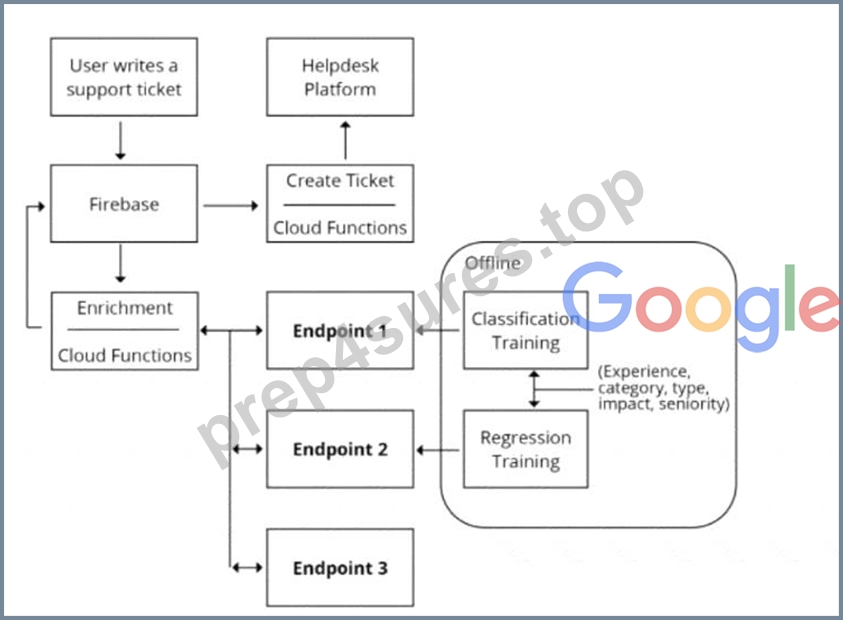
Which endpoints should the Enrichment Cloud Functions call?
- A. 1 = Vertex Al. 2 = Vertex Al. 3 = AutoML Vision
- B. 1 = Cloud Natural Language API. 2 = Vertex Al, 3 = Cloud Vision API
- C. 1 = Vertex Al. 2 = Vertex Al. 3 = Cloud Natural Language API
- D. 1 = Vertex Al. 2 = Vertex Al. 3 = AutoML Natural Language
Answer: C
Explanation:
Vertex AI is a unified platform for building and deploying ML models on Google Cloud. It supports both custom and AutoML models, and provides various tools and services for ML development, such as Vertex Pipelines, Vertex Vizier, Vertex Explainable AI, and Vertex Feature Store. Vertex AI can be used to create models for predicting ticket priority and resolution time, as these are domain-specific tasks that require custom training data and evaluation metrics. Cloud Natural Language API is a pre-trained service that provides natural language understanding capabilities, such as sentiment analysis, entity analysis, syntax analysis, and content classification. Cloud Natural Language API can be used to perform sentiment analysis on the support tickets, as this is a general task that does not require domain-specific knowledge or jargon. The other options are not suitable for the given architecture. AutoML Natural Language and AutoML Vision are services that allow users to create custom natural language and vision models using their own data and labels. They are not needed for sentiment analysis, as Cloud Natural Language API already provides this functionality. Cloud Vision API is a pre-trained service that provides image analysis capabilities, such as object detection, face detection, text detection, and image labeling. It is not relevant for the support tickets, as they are not expected to have any images. References:
* Vertex AI documentation
* Cloud Natural Language API documentation
NEW QUESTION # 38
Your team frequently creates new ML models and runs experiments. Your team pushes code to a single repository hosted on Cloud Source Repositories. You want to create a continuous integration pipeline that automatically retrains the models whenever there is any modification of the code. What should be your first step to set up the CI pipeline?
- A. Configure a Cloud Function that builds the repository each time there is a code change.
- B. Configure a Cloud Build trigger with the event set as "Push to a branch"
- C. Configure a Cloud Build trigger with the event set as "Pull Request"
- D. Configure a Cloud Function that builds the repository each time a new branch is created.
Answer: B
Explanation:
According to the web search results, Cloud Build1 is a service that executes your builds on Google Cloud Platform infrastructure. Cloud Build can import source code from Cloud Source Repositories2, Cloud Storage, GitHub, Bitbucket, or any publicly hosted Git repository. Cloud Build allows you to create and manage build triggers, which are automated workflows that run whenever a code change is pushed to your source repository. You can use Cloud Build triggers to automatically retrain your ML models whenever there is any modification of the code. Therefore, option B is the best way to set up the CI pipeline for the given use case, as it allows you to configure a Cloud Build trigger with the event set as "Push to a branch", which means the trigger will run whenever a new commit is pushed to a specific branch of your source repository. The other options are not relevant or optimal for this scenario. Reference:
Cloud Build
Cloud Source Repositories
Google Professional Machine Learning Certification Exam 2023
Latest Google Professional Machine Learning Engineer Actual Free Exam Questions
NEW QUESTION # 39
You are developing a training pipeline for a new XGBoost classification model based on tabular data The data is stored in a BigQuery table You need to complete the following steps
1. Randomly split the data into training and evaluation datasets in a 65/35 ratio
2. Conduct feature engineering
3 Obtain metrics for the evaluation dataset.
4 Compare models trained in different pipeline executions
How should you execute these steps'?
- A. 1 Using Vertex Al Pipelines, add a component to divide the data into training and evaluation sets, and add another component for feature engineering
2. Enable auto logging of metrics in the training component.
3 Compare pipeline runs in Vertex Al Experiments - B. 1 In BigQuery ML use the create model statement with boosted_tree_classifier as the model type, and use BigQuery to handle the data splits.
2 Use ml transform to specify the feature engineering transformations, and train the model using the data in the table - C. 1 Using Vertex Al Pipelines, add a component to divide the data into training and evaluation sets, and add another component for feature engineering
2 Enable autologging of metrics in the training component
3 Compare models using the artifacts lineage in Vertex ML Metadata - D. 1 In BigQuery ML. use the create model statement with bocstzd_tree_classifier as the model type and use BigQuery to handle the data splits.
2 Use a SQL view to apply feature engineering and train the model using the data in that view
3. Compare the evaluation metrics of the models by using a SQL query with the ml. training_infc statement.
Answer: A
Explanation:
' 3. Compare the evaluation metrics of the models by using a SQL query with the ml. training_info statement.
NEW QUESTION # 40
You work for a large retailer and you need to build a model to predict customer churn. The company has a dataset of historical customer data, including customer demographics, purchase history, and website activity. You need to create the model in BigQuery ML and thoroughly evaluate its performance. What should you do?
- A. Create a logistic regression model in BigQuery ML Use the ml.confusion_matrix function to evaluate the model performance.
- B. Create a logistic regression model in BigQuery ML and register the model in Vertex Al Model Registry. Evaluate the model performance in Vertex Al.
- C. Create a linear regression model in BigQuery ML Use the ml. evaluate function to evaluate the model performance.
- D. Create a linear regression model in BigQuery ML and register the model in Vertex Al Model Registry Evaluate the model performance in Vertex Al.
Answer: B
NEW QUESTION # 41
You manage a team of data scientists who use a cloud-based backend system to submit training jobs. This system has become very difficult to administer, and you want to use a managed service instead. The data scientists you work with use many different frameworks, including Keras, PyTorch, theano. Scikit-team, and custom libraries. What should you do?
- A. Create a library of VM images on Compute Engine; and publish these images on a centralized repository
- B. Configure Kubeflow to run on Google Kubernetes Engine and receive training jobs through TFJob
- C. Set up Slurm workload manager to receive jobs that can be scheduled to run on your cloud infrastructure.
- D. Use the Al Platform custom containers feature to receive training jobs using any framework
Answer: D
Explanation:
because AI platform supported all the frameworks mentioned. And Kubeflow is not managed service in GCP. https://cloud.google.com/ai-platform/training/docs/getting-started-pytorch
https://cloud.google.com/ai-platform/training/docs/containers-overview#advantages_of_custom_containers Use the ML framework of your choice. If you can't find an AI Platform Training runtime version that supports the ML framework you want to use, then you can build a custom container that installs your chosen framework and use it to run jobs on AI Platform Training.
NEW QUESTION # 42
......
Free Professional-Machine-Learning-Engineer Exam Questions Professional-Machine-Learning-Engineer Actual Free Exam Questions: https://freedownload.prep4sures.top/Professional-Machine-Learning-Engineer-real-sheets.html